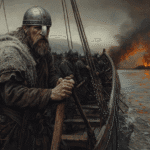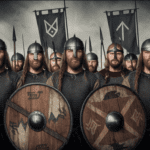

The Vikings left an indelible mark on Britain, transforming its lands, peoples, and institutions in ways that continue to resonate today. From the first terrifying raids to gradual cultural fusion, the Viking impact shaped language, governance, trade, and the very identity of England.
The Viking Arrival: Terror from the North
The first recorded Viking raid in England occurred in 789 AD, when “three ships of northmen” landed on the Isle of Portland in Dorset. They killed a local royal official who had come to meet them. However, the more infamous and widely remembered Viking attack took place four years later in 793 CE, with the raiding of the monastery on the island of Lindisfarne in Northumbria. This brutal event is often considered the beginning of the Viking Age in Europe. The following year, Norse raiders also attacked the monasteries at Jarrow (794), then Iona (795).
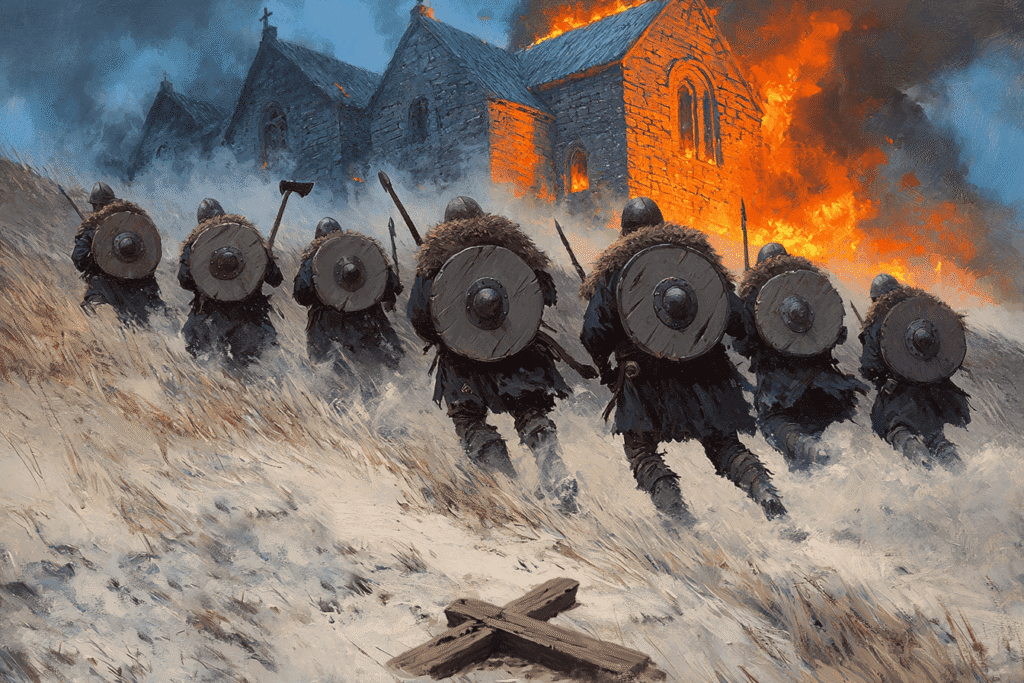
These acts, recounted with horror in the Anglo-Saxon Chronicle, signaled the start of relentless attacks along the coastlines. Monasteries and towns fell victim to these predators of the sea, drawn by the wealth of precious metals, goods, and slaves.
For the Anglo-Saxon kingdoms, the initial raids were a shock. Viking warbands, skilled in surprise attacks, devastated communities and exposed the vulnerabilities of British defenses. Over the next decades, Norse fleets became a constant menace, expanding their ambitions from looting to conquest.
Settlement and Danelaw: From Raiders to Rulers
Viking activities soon evolved from hit-and-run raids to the establishment of lasting settlements. The arrival of the ‘Great Heathen Army‘ in 865 marked a shift: Norse warriors defeated the armies of Northumbria, East Anglia, and Mercia, capturing modern York (Jorvik) and making it their capital.
The turning point was the creation of the Danelaw – vast swathes of northern and eastern England governed by Viking law, customs, and leaders. Cities like York flourished, transforming into major trading and manufacturing centers, with archaeological evidence of dense urban life. Viking rule encouraged craft production, international trade, and the minting of coins, demonstrating an advanced economy.
In the Danelaw and other settled territories, Norse transitioned from viking warriors to farmers and traders. They constructed towns, developed agricultural methods, and organized legal assemblies, such as the ting-vollr (assembly field) seen in the Isle of Man today.
Unifying the English
Perhaps the most significant Viking contribution to the building of Engand was the pressure it exerted on the Anglo-Saxon kingdoms to unify. The constant pressure from Viking incursions forced Anglo-Saxon rulers to recognize that unity was vital for survival. Over time, shared military campaigns and defensive systems created stronger bonds between the remaining free territories. Alfred’s successors, notably Edward the Elder and Æthelstan, exploited this unity by reconquering Viking-held lands and asserting overlordship over all English kingdoms. Æthelstan’s victory at Brunanburh in 937 symbolically and practically marked England’s emergence as a singularly unified realm.
Thus, the Vikings did not merely threaten England – they inadvertently catalysed its transformation. The need to face a common enemy accelerated military innovations, political alliances, and ultimately the centralization of power under one monarch, forging the foundations of a unified English state.
Conflict, Adaptation, and Cultural Blending
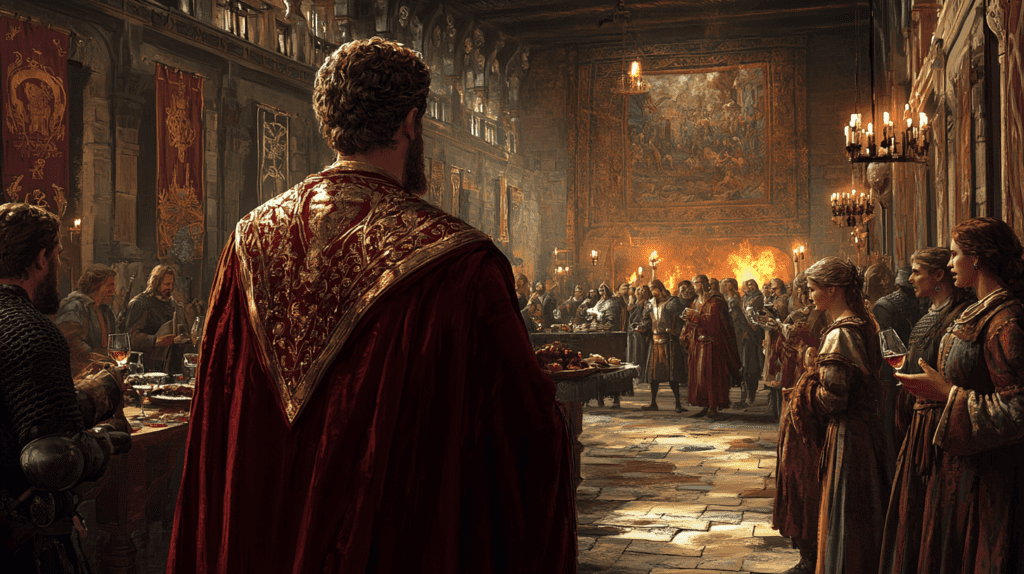
The Viking expansion was met with fierce resistance, most famously by Alfred the Great of Wessex. After intense battles such as Ashdown (871) and Edington (878), Alfred negotiated the Treaty of Wedmore, delineating Viking-controlled lands and commencing a period of uneasy coexistence.
Over generations, intermarriage and trade fostered the integration of Norse and Anglo-Saxon peoples. The heirs of Viking settlers became indistinguishable from their neighbors. Cultural blending was especially evident in place names – ‘by’ for farmstead, ‘thorp’ for village – and in the endurance of Norse words and dialects.
Military practices, legal traditions, and religious beliefs merged in complex ways. Viking assemblies influenced governance, and new legal concepts joined those of the Anglo-Saxons. The eventual Christianization of the Vikings further bridged divides, leading to shared religious and community practices.
Linguistic Legacy: Norse Words in Modern English
The Old Norse language left a profound imprint on modern English. Research shows hundreds of common words – from ‘sky’, ‘egg’, ‘knife’, and ‘window’, to pronouns like ‘they’, ‘them’, and ‘their’. Old Norse simplified many elements of Old English grammar, eased communication, and shaped regional dialects across the country.
Place names in Yorkshire, Lincolnshire, and throughout the North showcase Norse roots. Everyday speech in these regions retains words for natural features – ‘dale’ (valley), ‘beck’ (stream), ‘fell’ (hill) – reflecting a legacy that’s both linguistic and geographical.
Urban, Economic, and Social Development
The Viking age stimulated urban growth and economic change. Towns like Jorvik/York saw explosive population rises, driven by trade networks stretching from the Baltic to the Mediterranean. Norse influence introduced new crafts, manufacturing techniques, and broader connections, transforming local economies.
Viking settlement prompted innovations in agriculture, including improved land clearance, water management, and animal husbandry. These advances accelerated England’s transition from isolated communities to interconnected, prosperous regions.
Socially, the Vikings contributed to a more pluralistic society. Their assimilation offered a model for later waves of migration and cultural fusion. Regions once dominated by Norse customs became melting pots, enriching the nation’s ethnic tapestry.

Governance and Law: Norse Contributions
One of the most overlooked Viking impacts is the transformation of British law and governance. Norse legal customs, such as trial by assembly and consensus decision-making, influenced Anglo-Saxon and eventually English administrative models. In the Danelaw, assemblies like the ‘ting’ mirrored Anglo-Saxon moots and evolved into enduring institutions.
Viking rule demanded efficient tax collection, legal arbitration, and dispute resolution. The routines of Norse administration helped build a foundation for the English common law tradition, as well as the unity of the realm that would later become the Kingdom of England. In places like the Isle of Man, the Tynwald assembly survives as one of Europe’s oldest continuous parliaments.
Genes and Identity: Viking Roots in Britain Today
The genetic legacy of the Vikings is evident in modern Britain, especially in the north and east. DNA studies have shown significant Scandinavian ancestry in communities like Yorkshire, Cumbria, and the Scottish islands. This invisible heritage reinforces the diversity and enduring influence of the Viking era.
Many family names, personal names, and local customs trace back to Viking ancestors. The celebration of Viking festivals, commemorations, and reenactments continue to draw thousands of visitors, demonstrating the deep roots of Norse culture in British identity.
Maritime Tradition and Exploration
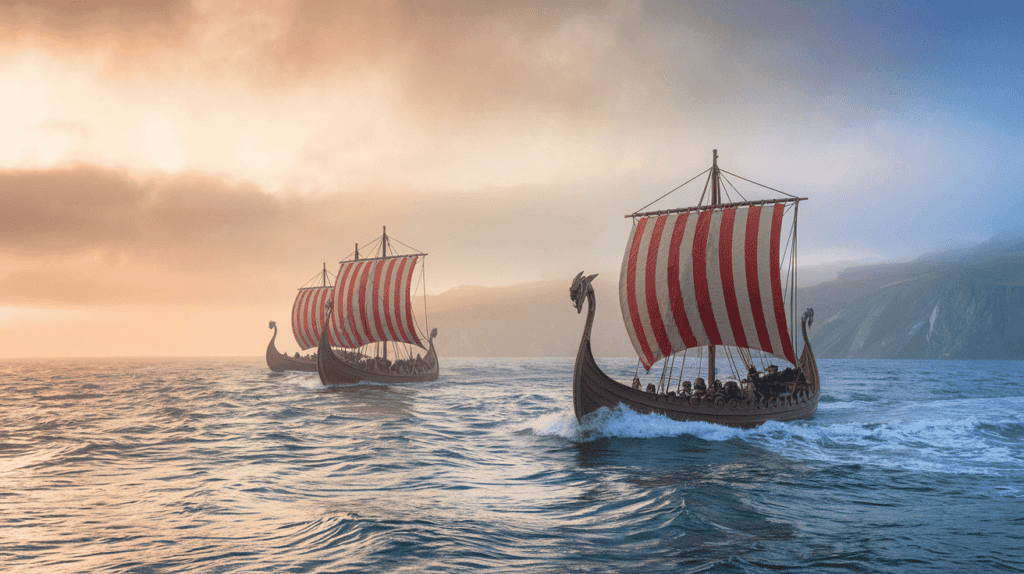
The Vikings were exceptional seafarers, and their navigational skills transformed Britain’s maritime history. English ship design, trade routes, and exploration benefited from Norse innovations. Over centuries, England’s rise as a naval power drew directly from lessons and legacies left by Viking mariners.
The End of the Viking Era and Lasting Impact
The era of Viking power waned after the Battle of Stamford Bridge in 1066, where English forces defeated the Norwegians. However, their legacy endured; the foundations laid in law, urban life, and culture persisted into the Norman period and beyond.
The Vikings shaped Britain in ways that are immediately visible and subtly enduring. Their arrival unleashed chaos, but ultimately fostered unity, innovation, and cultural diversity. The place names, language, institutions, and even some of the bloodlines of Britain traced to Viking origins.
From raiders to rulers, the Vikings sparked transformations that turned fragmented Anglo-Saxon kingdoms into a society primed for collective identity and later greatness. Their impact on governance, law, economy, language, and coexistence laid vital groundwork for the future nation of England. However, ultimately it was the Anglo-Saxon need to face the common viking enemy that forced political alliances and the centralization of power under one monarch, forging the foundations of a unified English state.