

Few celestial events have so dramatically shaped the human imagination as the periodic visit of Halley’s Comet. Visible roughly every 75–79 years, ancient astronomers recorded it, medieval peoples feared it as a fiery omen, and in 1066 it supposedly underscored one of the most transformative years in English history – the Norman conquest.
Halley’s Comet: A Celestial Regular
What actually is Halley’s Comet? A comet is essentially a ball of ice and dust orbiting the sun along an elongated path. As it nears the sun, solar radiation vaporizes its surface, forming the glowing coma and long luminous tail. Unlike planets, comets rarely stick to simple predictions, at least before modern orbital mechanics clarified their movements.
What distinguishes Halley’s Comet is its periodic return. Sir Edmond Halley, in the early 18th century, compared records of comet sightings from 1531, 1607, and 1682 and realized they described the same object returning approximately every 76 years. When he predicted its next return for 1758, making one of the earliest successful astronomical forecasts, his name became linked forever to this visitor. Retrospectively, earlier comet sightings – including the one that streaked across medieval skies in 1066 – were identified as past appearances of Halley’s Comet.
Thus, when we talk about pre-modern sightings, contemporaries did not know they were viewing “Halley’s.” Each generation believed it was seeing a unique prodigy in the sky.
Comets as Omens in Early Cultures
Before the advent of modern astronomy, few phenomena spurred as much wonder and dread as comets. Unlike the reliable motions of planets and stars, comets were irregular and surprising. Their sudden appearance with streaming tails suggested fires in the heavens – literally breaches in the cosmic order.

- Chinese Sources: The Han dynasty kept meticulous astronomical registers. Chinese court astrologers recorded “broom stars” (a common name for comets, from the tails resembling broom heads). Each sighting was tied to dynastic fortunes, wars, or famines. Halley’s Comet, for example, appears clearly in Chinese records as early as 240 BCE and in multiple subsequent appearances. These records became vital in confirming Halley’s periodicity.
- Babylonian Observers: The Babylonians, masters of celestial cataloging, also noted cometary appearances. Their belief system tied unusual astronomical phenomena to the fate of kings. A comet could imply danger, rebellion, or divine disfavor.
- Greek and Roman Reactions: Greek philosophers theorized comets as atmospheric phenomena or “exhalations.” Aristotle considered them transient fires within the sub-lunar realm, distinct from the eternal heavens. Romans, deeply superstitious, tied comets to imperial destiny. Pliny the Elder described them as blazing stars with long hair—the Latin word cometes comes from kometes, “hairy star.”
Thus, even in antiquity, the recurrent appearances of Halley’s Comet left traces across continents, though no one knew it was the same object.
Documented Pre‑1066 Appearances
Halley’s Comet’s orbit allows us to retroactively calculate its earlier passages. Scholars, cross‑referencing Chinese, Babylonian, and European annals, have reconstructed major appearances before 1066:
- 240 BCE (China): The earliest confirmed record. Han dynasty chroniclers described a broom star lingering for 56 days. This entry is now regarded as the definitive first sighting tied to Halley’s Comet.
- 164 BCE (Babylon and China): Recorded in cuneiform tablets and Chinese registers.
- 87 BCE (Rome): Possibly linked to the death and deification of Julius Caesar in 44 BCE, though historians debate which comet that was. Still, Romans often linked comets to great imperial shifts.
- 12 BCE (China, possibly Rome): Seen in multiple cultures. Some Christian commentators much later speculated that the Star of Bethlehem might have been this comet, but most historians find this improbable; still, the speculation fueled medieval imagination.
- 66 CE: Around the time of the Jewish Revolt against Rome. Josephus described a “star resembling a sword” seen in the skies – a description many believe was Halley’s Comet. Apocalyptic interpreters took it as an omen of Jerusalem’s coming destruction.
- 141 CE and 218 CE: Again recorded in China, emphasizing their consistent record-keeping.
- 451 CE: Visible during the waning years of the Western Roman Empire, seen over Europe.
- 837 CE: This was Halley’s most spectacular medieval appearance, with a tail said to stretch across half the sky. Contemporary chroniclers across Europe and Asia reported it vividly.
By the 9th and 10th centuries, Halley’s appearances were feared portents across Christendom, Islamicate lands, and East Asia alike.
The Year of Destiny: 1066
The Political Landscape
The year 1066 was a turning point in English and European history. England’s throne was unstable following the death of Edward the Confessor in January. He left no direct heir. Three powerful men laid claim: Harold Godwinson, Earl of Wessex; William, Duke of Normandy; and Harald Hardrada, King of Norway. The English crown seemed destined for conflict, and that conflict would decide the fate of the realm.
- Harold Godwinson seized the crown immediately, crowned in Westminster Abbey in January 1066.
- William of Normandy claimed Edward had promised the throne to him.
- Harald Hardrada the Norwegian king claimed support through dynastic treaties.
Amid this precarious situation, an otherworldly spectacle arrived: Halley’s Comet.
The April–May Appearance
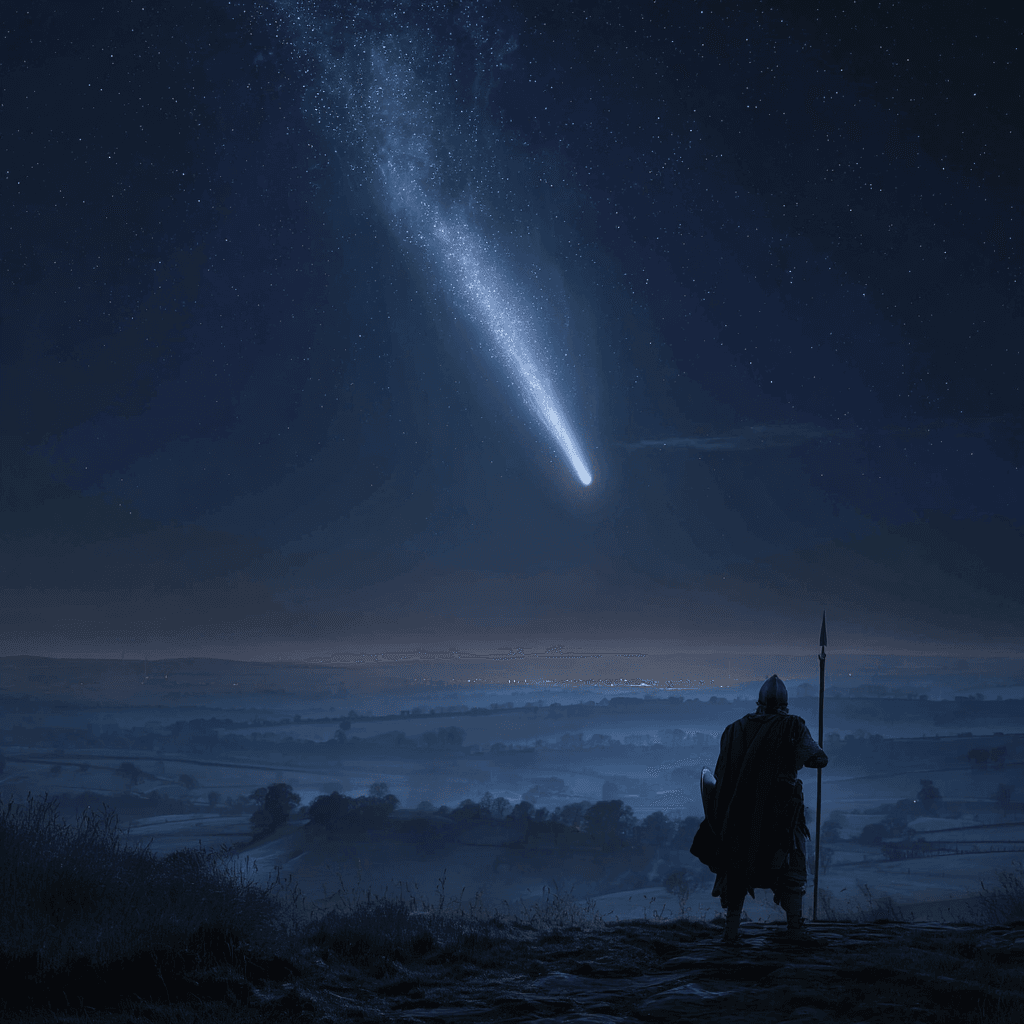
Halley’s Comet made its appearance in April 1066, blazing across the night sky for weeks. Contemporary chroniclers describe it as unusually bright, inspiring both awe and dread. The Anglo-Saxon Chronicle notes: “A sign appeared in the heavens such as men never saw before. A star most wonderful, darting its rays, appeared for many nights.”
The comet rose soon after Harold’s coronation. For medieval people steeped in astrology and providential thinking, the timing was inescapable: the heavens themselves spoke, but in what tongue? To Harold’s enemies, it meant doom for him and England. To others, it symbolized divine approval or an omen of trial.
The Anglo-Saxon Chronicle noted that a monk from Malmesbury may have seen Halley’s comet both in 989 and 1066, and feared the second:
Not long after, a comet, portending (they say) a change in governments, appeared, trailing its long flaming hair through the empty sky: concerning which there was a fine saying of a monk of our monastery called Æthelmær. Crouching in terror at the sight of the gleaming star, “You’ve come, have you?”, he said. “You’ve come, you source of tears to many mothers. It is long since I saw you; but as I see you now you are much more terrible, for I see you brandishing the downfall of my country.”
The Bayeux Tapestry and the Omen
The most iconic image of Halley’s 1066 appearance is immortalized in the Bayeux Tapestry, a 70‑meter embroidered chronicle commissioned by Normandy after its conquest of England. This is probably the oldest recorded image of the comet. One panel shows figures pointing skyward at a flaming star with streaming tail. Above, stitched words read: ISTI MIRANT STELLA (“These men marvel at the star”). Another shows King Harold seated, seemingly troubled by news, while subjects whisper of the portent.
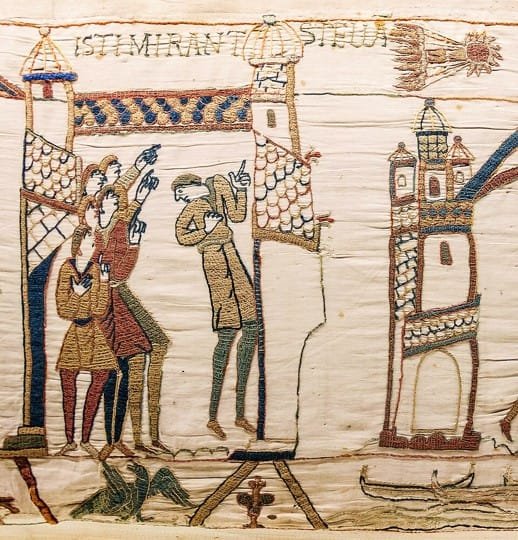
This artwork alone ensures Halley’s Comet a place in the cultural story of the Norman Conquest. Whether Harold himself took it seriously, we cannot know, but the tapestry portrays it as an omen foreshadowing William’s victory.
Reactions Across Christendom
Chroniclers across Europe noted the comet. William of Jumièges, a Norman historian, called it a sign from God revealing “the change of a kingdom.” Florence of Worcester, in England, echoed the Anglo-Saxon Chronicle in marveling at its brilliance. To Christian monks, educated in the theology of signs, the comet symbolized divine judgment.
Norman propagandists naturally spun the comet as heaven’s approval of William’s claim. Later medieval writers would memorialize the fiery star as an omen of Harold’s downfall and England’s transformation.
Later Events of the Year
Indeed, the year lived up to the sense of destiny. September saw Harold Godwinson successfully repel Harald Hardrada’s Viking invasion at Stamford Bridge (Hardrada was killed). Immediately afterward, Harold marched south to meet William of Normandy, who had landed in Sussex. At Hastings in October, Harold was slain, and William established Norman rule.
The comet embodied the sense that forces beyond earthly control had ushered in a new era. The Norman Conquest reshaped England’s aristocracy, language, church, and connections to continental Europe. Thus Halley’s Comet became forever tied to this foundational pivot in English history.
Earlier Medieval Reactions to Halley’s Comet
837 CE: The Great Comet
The 9th‑century appearance of Halley’s Comet in 837 may have been the most dramatic in history. Astronomical reconstructions suggest the comet passed closer to Earth than at any other time in the Common Era. Chroniclers describe a tail that cut the heavens, greater than the span of the sky. In China and Japan, it was recorded meticulously, with descriptions of length, brightness, and direction.
In Europe, the Annals of Fulda mentioned it as tinged with blood, terrifying peasants and rulers alike. To Carolingian elites, it underscored turbulent times between dynastic heirs of Charlemagne.
451 CE: Rome in Crisis
Another celebrated appearance coincided with Attila the Hun’s campaigns in the West. Later chroniclers retrospectively tied comets to these disasters, suggesting fiery stars had foretold Attila’s invasion of Gaul. Whether contemporaries made the link immediately or later, the narrative of comet as harbinger of foreign invasion was entrenched long before 1066.
Comets in Medieval Mentalities
To grasp why Halley’s Comet of 1066 mattered so much, we must understand medieval cosmology. Medieval Europeans lived under a synthesis of Christian theology and Aristotelian astronomy. The heavens were seen as a realm of divine order: planets moved in perfect spheres, stars never varied, and the sky reflected God’s harmony. Thus a comet – erratic, fiery, disruptive – represented disorder, a breach in the cosmic order.
Comets were believed to presage:
- The fall of kings and kingdoms
- Outbreaks of plague or famine
- Earthquakes or cosmic upheaval
Astrologers in royal courts rushed to interpret them. Clergy preached about repentance. Common peasants muttered about doom. Modern minds, trained to see comets scientifically, must grasp that for medieval people, celestial events were charged with moral and political significance.
Thus, in 1066, a radiant comet following swiftly on Harold’s coronation was bound to shake imaginations. And in hindsight, since Harold fell and William triumphed, the omen seemed verified.

Conclusion
The sighting of Halley’s Comet in 1066 is more than a curious overlap of astronomical and political history. It is a reminder that human beings have always sought meaning in the heavens: sometimes finding warnings, sometimes reassurance, sometimes data for science. In 1066, the fiery star was woven into the legend of England’s destiny. But before and after, across civilizations, it has been the same comet – an unpredictable messenger whose meanings are supplied by human imagination.
Time and again, Halley’s Comet has returned, each time meeting a different world. In 240 BCE it was a broom star presaging dynastic change. In 837 CE, a fearsome harbinger stretching across the sky. In 1066, the herald of conquest. In 1758, a vindication of Newton and Halley.


Great article. It could have also mentioned that the English historians consider the Norman Invasion and the year 1066 as the most pivotal in English history.