

Baldwin I of Flanders, better known to legend as Baldwin Iron Arm, stands at the hazy frontier where Carolingian imperial order gave way to the fiercely independent principalities of the medieval Low Countries. His story blends elopement, excommunication, Viking war, and hard-nosed frontier politics into a near-perfect origin myth for one of medieval Europe’s most powerful dynasties.
A frontier lord in a crumbling empire
Baldwin was born in the 830s, in the northern reaches of the West Frankish kingdom that would one day become France and Belgium. The sources disagree on his precise background, but he appears as a Frankish noble of modest stature, perhaps related to regional counts, and already holding some local authority around Ghent before his great leap into high politics. His world was that of a shrinking Carolingian order: royal authority was fraying, magnates were growing bolder, and Viking fleets were exploiting every weakness along the North Sea coast.
By Baldwin’s youth, the coastlands of what would become Flanders had become a bleeding frontier. Viking warbands sailed up the estuaries, burned markets and monasteries, and ransomed or carried off captives, while royal armies struggled to respond quickly across long distances. In that setting, a tough local warlord with the king’s blessing could make or break both royal strategy and regional survival. Baldwin Iron Arm would become exactly that man—but only after a scandal that could easily have destroyed him.
Judith: the scandalous royal bride
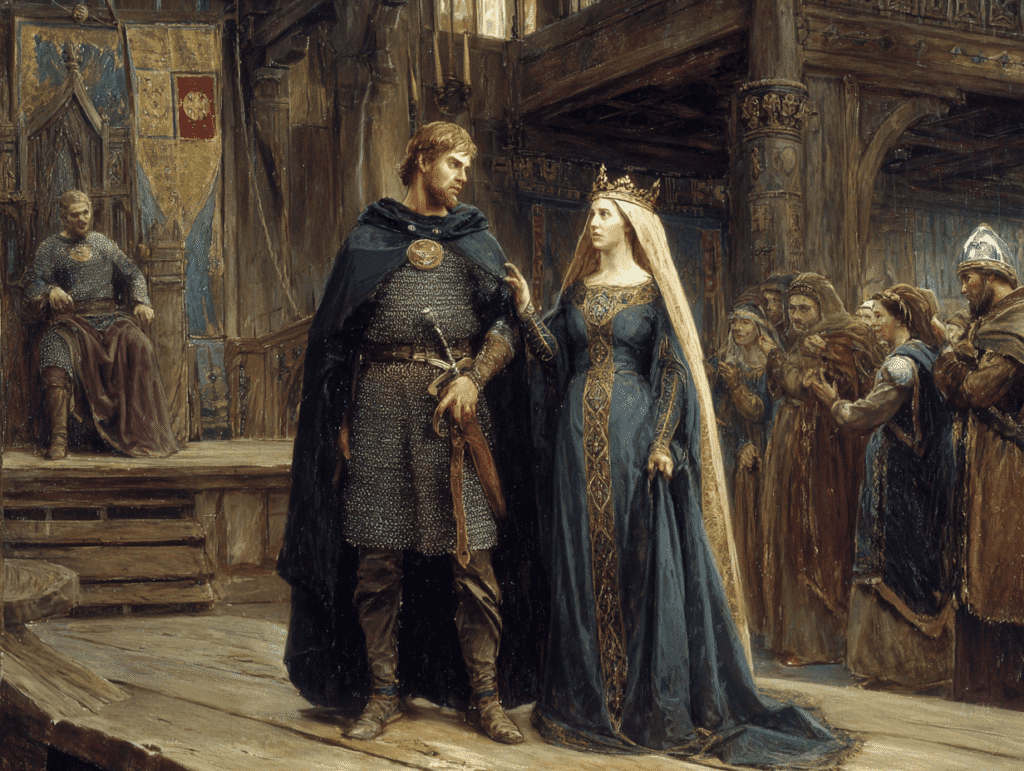
Baldwin first truly enters the historical spotlight around 862, through an act that reads like something out of a romance: he carried off Judith, daughter of King Charles the Bald, king of West Francia and grandson of Charlemagne. Baldwin married Judith without the king’s consent. Judith herself was already famous and politically sensitive; as a young teenager she had been married successively to two kings of Wessex – Æthelwulf and then his son Æthelbald – and returned a widowed royal princess to her father’s court after those English unions ended.
To Charles, Judith was a dynastic asset; to Baldwin, she was both a powerful bride and likely a willing partner in rebellion. The sources are hostile to Baldwin and paint the marriage as abduction, but the way Judith stayed with him, shared his fortune, and gave him heirs strongly suggests something more complex than a crude kidnapping. Either way, the political facts were simple: a relatively minor count had just married into the royal family without the king’s blessing, seizing a princess who had already played a part in high-stakes international diplomacy.
Excommunicated rebel, pilgrim to Rome
Charles the Bald reacted with a fury that tells us how seriously he took the insult. Baldwin and Judith were excommunicated – cut off from the Church and socially tainted, which in a society built on Christian legitimacy was meant to make them untouchable. Royal propaganda cast Baldwin as an upstart seducer and troublemaker, and the king appears to have hoped that cutting him off from ecclesiastical support would isolate him.
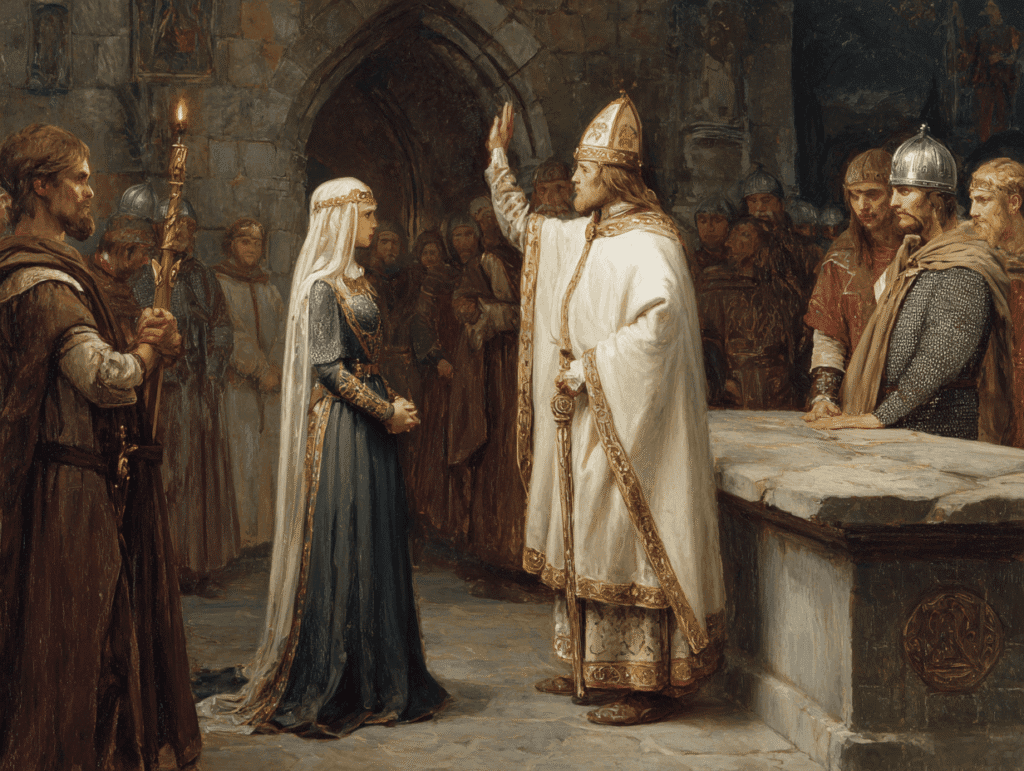
Instead, the couple doubled down on their gamble. Baldwin traveled to Rome and appealed directly to Pope Nicholas I, asking the pontiff to recognize the marriage as valid and overturn the excommunication. This was a daring move for a frontier noble: it bypassed the king, turned a romantic scandal into a legal-theological dispute, and forced the papacy to weigh in on the internal affairs of the West Frankish kingdom.
Nicholas backed Baldwin and Judith. The pope ruled in favor of the couple’s union, ordered bishops to withdraw the excommunication, and effectively told Charles that he had to reconcile with his errant son-in-law. In political terms, Baldwin had just pulled off a remarkable coup: he transformed himself from an excommunicated abductor into a papally defended royal husband.
From outlaw to margrave
Once the pope had spoken, Charles the Bald had little choice but to make the best of a bad situation. He still did not forgive Baldwin in any warm sense, but he regularized the marriage and, crucially, gave Baldwin land and office in a way that tied his fortunes to royal policy on the northern frontier. Baldwin first appears as count at Ghent, and by around 864 he is styled margrave (marchio) of Flanders – a frontier military governor charged with defending the realm’s vulnerable edge.
Some later commentary even suggests that Charles may have hoped Baldwin would be killed in the process, throwing him into the Viking-ravaged marches with responsibilities that might outstrip his means. If that was the king’s calculation, it misfired spectacularly. Rather than collapsing, Baldwin built a power base that would outlast the Carolingian dynasty itself.
The title “margrave” mattered. A margrave on a hostile frontier needed wide latitude: the right to raise forces quickly, fortify key sites, and negotiate, fight, or punish with only intermittent oversight from the distant royal court. To function at all, such an office demanded a degree of autonomy that could easily evolve into hereditary rule – precisely what happened in Flanders.
Iron Arm against the Vikings
The nickname “Iron Arm” does not appear in contemporary ninth‑century documents; it surfaces in later twelfth‑century accounts, associated with Baldwin’s reputed strength and determination. Even if legendary, the epithet captures how later generations understood his role: an almost superhumanly tough warlord standing between Viking fleets and the rich inland heartlands of the Frankish kingdom.
The coastal rivers of Flanders, especially the Scheldt and its branches, offered perfect avenues of attack. Viking raiders moved fast, struck soft targets like monasteries and unwalled trading settlements, and vanished before a royal army could assemble. Baldwin’s task was to change that balance by hardening the coast into a defensible military zone.
He did this in large part through fortification. In 867 he built a castle at Ghent, turning what had been a vulnerable locality into the armored core of his emerging principality. Around this stronghold, a town grew that became the political seat of his rule, with the castle functioning as both a military redoubt and a symbol of comital authority. Baldwin also constructed or reinforced a castle at Bruges, the North Sea port whose control was essential for monitoring maritime traffic and intercepting raiders.
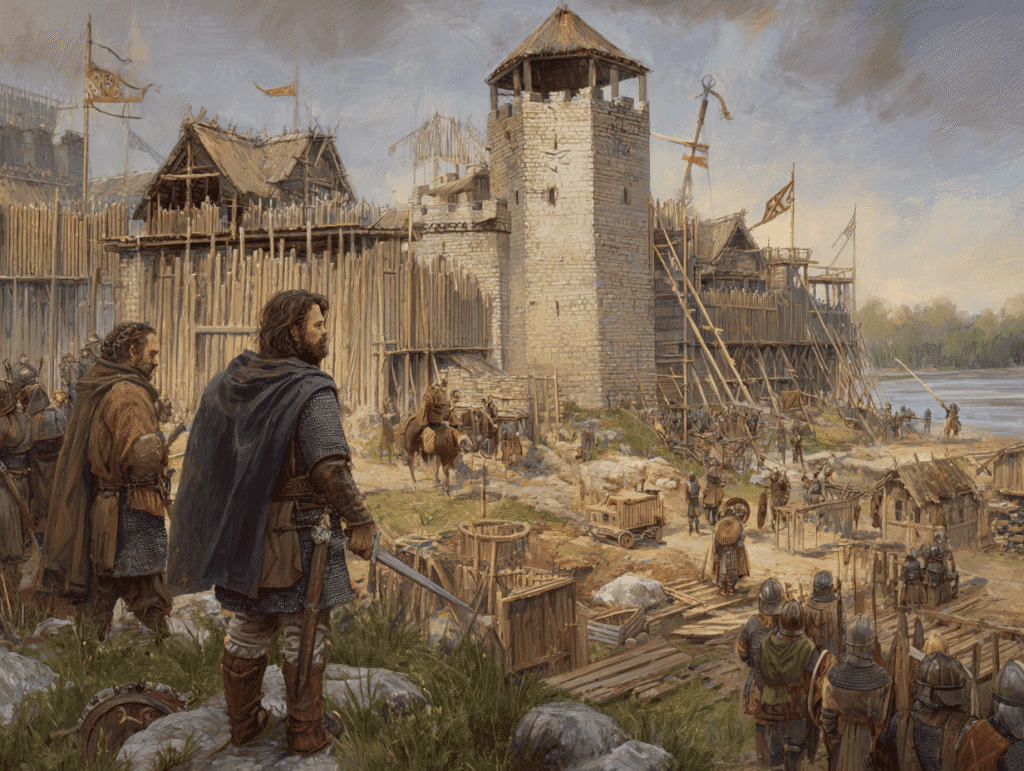
These fortresses were more than stone and timber. They anchored a defensive system: rallying points for local levies, refuges for merchants and peasants, and bases from which Baldwin’s mounted forces could strike back against Viking camps. Chronicles and later tradition emphasize the ferocity of his response to any attack on his lands, describing harsh and uncompromising treatment of raiders that contributed to the aura behind the “Iron Arm” legend.
Forging the county of Flanders
A crucial part of Baldwin’s significance lies not just in what he defended, but in what he built. Over the course of his rule he transformed a set of vulnerable border districts into a coherent and expanding principality that posterity would know as the county of Flanders. Starting from Ghent, he acquired additional territories: by 870 he held the lay abbacy of Saint Peter’s Abbey in Ghent and likely also controlled regions such as the Waasland and the Ternois, among others.
Holding a lay abbacy meant that Baldwin controlled the revenues and patronage of a major monastery without being a cleric himself. This strengthened his fiscal base, allowed him to reward followers, and tied the Church’s local presence directly into comital power. In a world where wealth was often locked in ecclesiastical institutions, such control provided both resources and legitimacy.
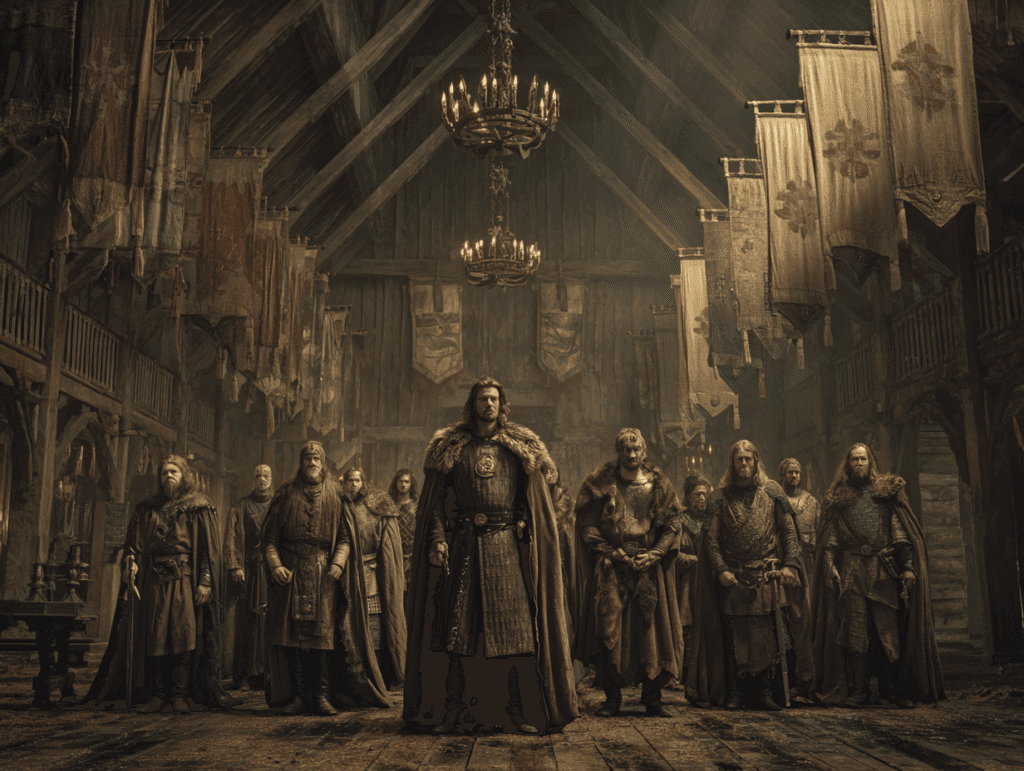
The evolution of his title tells the rest of the story. Baldwin was originally a royal appointee, a “margrave of Flanders” holding an office on behalf of his king. Yet within a generation, the office had hardened into a hereditary county. By the early tenth century, Baldwin’s descendants were no longer thought of as mere border officials but as counts of Flanders – sovereign-like rulers whose authority approached that of small kings.
The Iron Arm as dynastic founder
Baldwin’s marriage to Judith proved as important for dynastic politics as his military and territorial achievements. Through her, he anchored his line into Carolingian royal blood, giving his descendants a pedigree that would later support high-status marriages and strategic alliances. Judith herself emerges as more than just a passive prize: twice a queen in England and then the partner of a frontier lord, she embodied the transnational aristocratic networks of the ninth century.
The couple’s known children included Baldwin II, who succeeded his father and continued the work of consolidating and extending Flemish power. From there, the comital house of Flanders expanded its influence across generations, intermarrying with kings of France, England, and other principalities, and at times playing kingmaker in wider European politics. The legend of Baldwin Iron Arm, therefore, became not just a local story but a foundational myth for a dynasty that mattered on the continental stage.
Baldwin died in 879 and was buried at the abbey of Saint-Bertin near Saint-Omer, an important religious and cultural center of the region. His burial there symbolized both his piety in the eyes of contemporaries and his integration into the monastic and ecclesiastical landscape that underpinned elite power in the ninth century. By the time of his death, what had begun as royal damage control – a risky appointment of an inconvenient son‑in‑law to a dangerous frontier – had turned into the birth of a semi-independent state.
Legend, memory, and the making of a hero
Much of Baldwin’s later legend was crafted by chroniclers writing centuries afterward. The epithet “Iron Arm” itself is a product of that later memory, attached to him by a twelfth‑century writer who emphasized his strength and daring in compact, almost formulaic phrases. Such retroactive glorification was common: later generations liked their founders to be larger than life, and Baldwin, with his elopement, papal drama, Viking wars, and dynastic success, offered rich material.
Yet the core of the legend matches the hard structures visible in the record. The castles at Ghent and Bruges are historical, as is the shift from margravial office to comital patrimony. The steady expansion of territory, the entanglement with monasteries, and the gradual thickening of a regional identity in Flanders all point back to a ninth‑century moment when one man, entrusted with a desperate job, chose to turn his royal appointment into a family inheritance.
In that sense, Baldwin Iron Arm embodies a broader pattern across post‑Carolingian Europe. As kings struggled to project power, frontier commanders, marcher lords, and regional counts stepped into the vacuum, building fortified networks and hereditary dynasties that would become the principalities of the high Middle Ages. Flanders with its cloth towns, merchant guilds, and powerful counts was one of the brightest of these new political stars – and its rise begins with a man whose “iron arm” may have been as much about political will as about raw physical strength.