
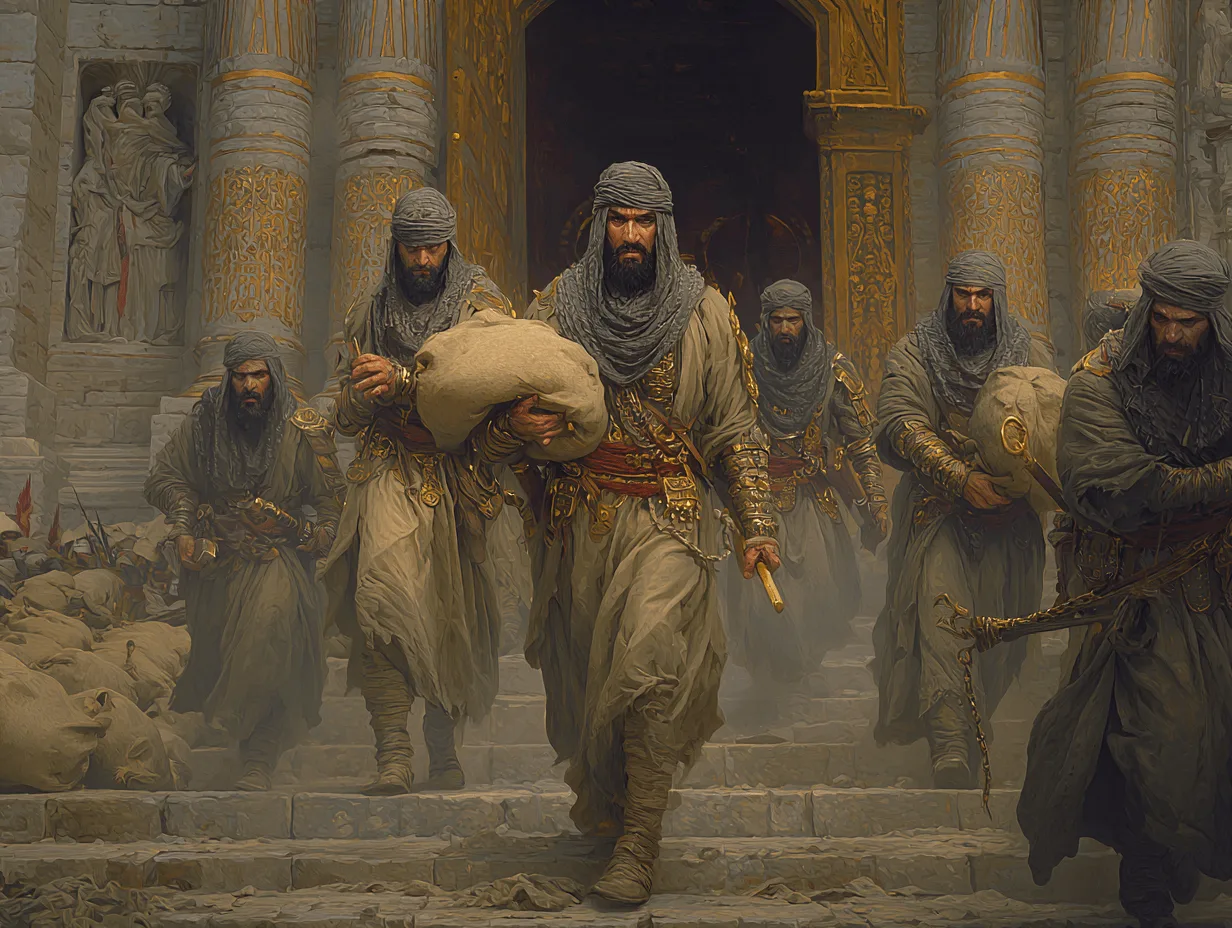
The year 846 stands as one of the most dramatic and formative moments in Rome’s long and embattled history. In that fateful year, Muslim raiders, commonly labelled as Saracens in the contemporary chronicles, undertook a daring maritime assault that rocked the Christian world: they plundered the outskirts of Rome, sacked the legendary Old St. Peter’s Basilica and Saint Paul’s-Outside-the-Walls, and made off with treasures and relics that had been amassed over centuries.
The Mediterranean in the Ninth Century: Storm Clouds Gather
To understand the magnitude of the 846 raid, we must first situate it within the turbulent context of Mediterranean geopolitics in the early Middle Ages. The Muslim world, under the dynamic leadership of the Aghlabids of Ifriqiya (in present-day Tunisia), was expanding aggressively. By the 820s, they had set their sights on Sicily, a vital stepping stone for further incursions into southern Europe.
After their conquest of Messina in 842, Arab forces consolidated their power, using Sicily and allied coastal bases in southern Italy as springboards for raids deeper into Christian territories. At this very moment, the Italian peninsula was fractured by internal strife: the civil war among Lombard princes in Benevento had led both sides to hire Muslim mercenaries, bringing Saracen warriors even closer to Rome itself.

Rome in the Ninth Century: A City Exposed
Rome in 846, though still the symbolic heart of western Christendom, was a shadow of its imperial self. Politically, it was the capital of the Papal States and a spiritual beacon, but it was not a military powerhouse. The city’s iconic walls – erected centuries before by Emperor Aurelian – offered formidable protection to the urban core, but much of the city’s wealth and its holiest shrines, most notably Old St. Peter’s Basilica and St. Paul’s-Outside-the-Walls, lay outside these defenses.
These basilicas were renowned far beyond Rome, attracting pilgrims and donations from across Christendom. Over time, they became repositories for treasures: golden crosses, jeweled reliquaries, chalices, and the gifts of emperors and kings. Crucially, they also held sacred relics: remnants of saints, objects associated with Christ, and, in the case of Old St. Peter’s, the very tomb of the apostle Peter himself.
The Raid Unfolds
In the late summer of 846, a well-coordinated Muslim force launched its assault. Sailing from bases along the Tyrrhenian coast and perhaps even from Sicily, detachments landed at Ostia and Porto, Rome’s port cities at the mouth of the Tiber, as well as at Centumcellae (modern Civitavecchia). The city’s defensive garrisons at Nova Ostia were quickly overwhelmed, and the raiders, following the river and coastal routes, advanced towards the great basilicas.
The approach was swift and professional: the Aurelian Walls, encircling Rome itself, were wisely left alone; the raiders, seasoned in Mediterranean warfare, recognized the futility of a protracted siege. Instead, they targeted the unprotected jewels in the papal crown: St. Peter’s and St. Paul’s: institutions that embodied the heart and legacy of Christianity but, tragically, were nearly defenseless.
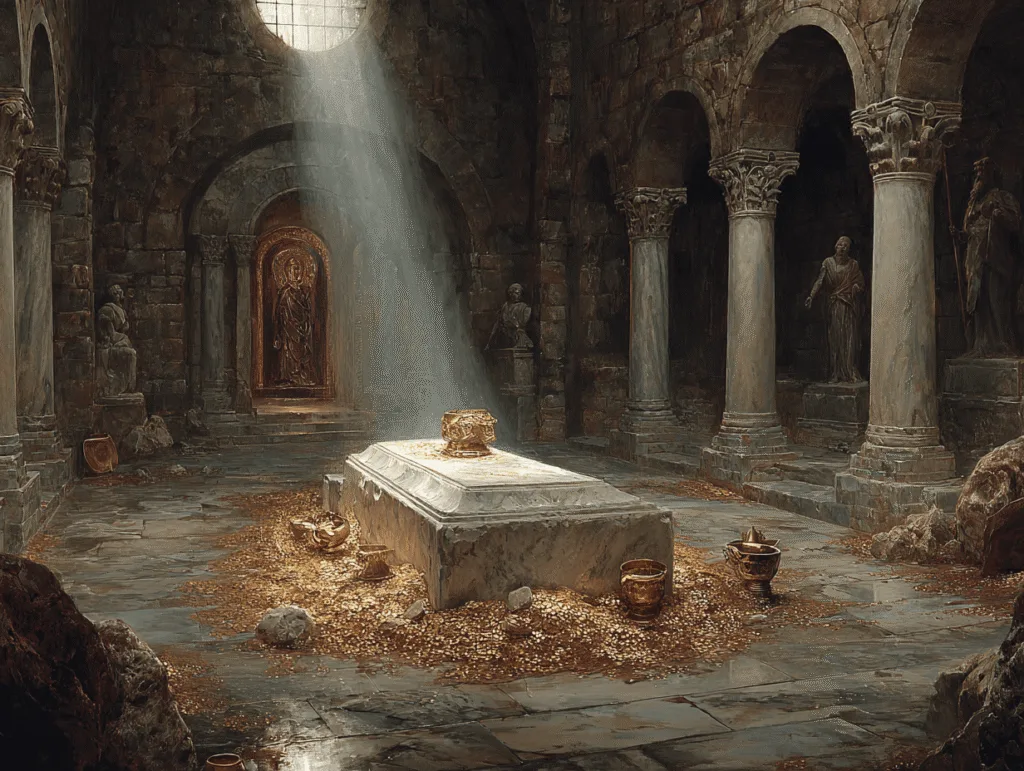
Inside these basilicas waited treasure troves: processional crosses glittering with rubies and emeralds, golden candelabra, silver tables donated by Charlemagne, and numerous reliquaries of the saints. Contemporary chronicles state pointedly that the Saracens seemed to know “exactly where to look”; some speculate they had received insider information about the layout and riches of the shrines.
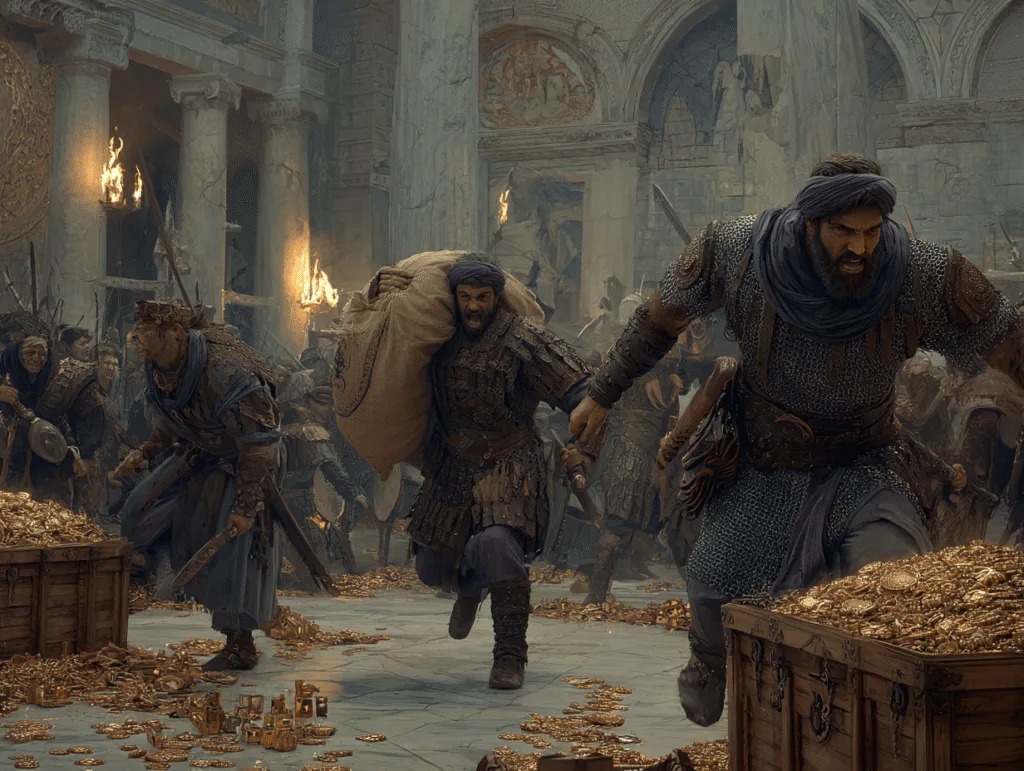
The sacking was a nightmare for Romans: relics were looted, precious objects were melted or hauled away, and the sanctity of the very tomb of St. Peter was desecrated. The defenders, militias drawn from papal “scholae” (communities of Saxons, Lombards, Frisians, and Franks living in the district), put up a brave but ultimately futile resistance.
The Wider Response: Counterattack and Vengeance
Word of the attacks spread rapidly. The Roman militias retreated into the safety of the city proper, while outside the walls, chaos reigned. The Saracens gathered their booty and prisoners, but their victory would soon be challenged.
A counterattack was mustered by the Duke Guy of Spoleto, leading a force of Lombards and allied Christian militias. They ambushed segments of the raiders near the city walls and pursued others as far as Centumcellae. Simultaneously, some Saracen groups tried to reach the sea at Misenum, only to be cut off.
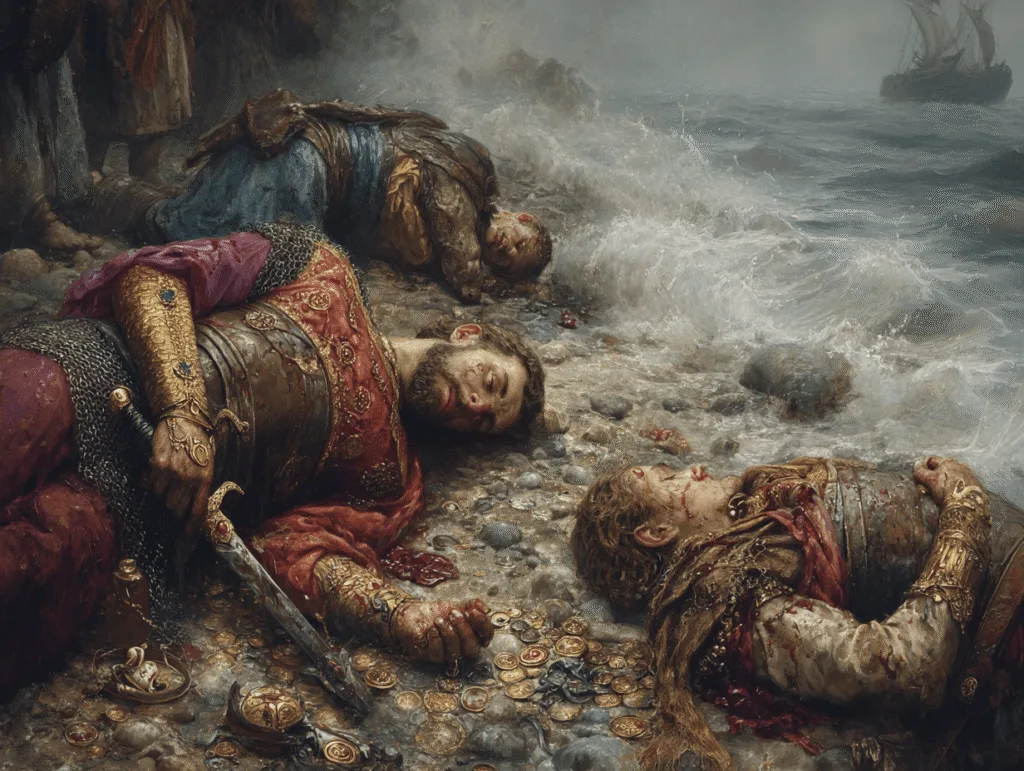
Nature itself intervened as a fierce storm destroyed many of the fleeing raiders’ ships, washing countless adorned corpses ashore – many still bearing jewels and captured treasures that were promptly recaptured by local Italians. The remainder of the fleeing Saracens would be met and further harried at Gaeta by Neapolitan forces under Cesarius, son of Sergius, Magister Militum of Naples, who ultimately dealt a further blow in favor of the Christian coalition.
The Aftermath: Shockwaves Through Christendom
The immediate consequences of the raid were profound. The physical looting was bad enough – priceless relics lost, churches desecrated, Roman pride wounded – but the psychological blow was arguably worse. For the first time in centuries, Rome, the eternal city, the very heart of western Christianity, had been violated not by schismatic Christians or pagan barbarians but by Muslim raiders from across the Mediterranean.
The event galvanized the city. Pope Leo IV, understanding the new realities of Mediterranean warfare, began constructing the Leonine Wall, a massive fortification on the right bank of the Tiber designed to protect St. Peter’s and its suburbium in the future. This new defensive barrier, encircling the Vatican and Castel Sant’Angelo, created what became known as the Leonine City: a unique administrative entity that would not be merged with Rome proper until the sixteenth century.
The raid also changed papal diplomacy. In the ensuing decades, the Papal States found themselves increasingly isolated militarily. By the reign of Pope John VIII (872-882), the Muslim threat to Rome and the Tyrrhenian coastline had grown so dire that the pope felt compelled to pay tribute – 25,000 silver mancusi – to Muslim powers to secure the peace. John VIII would berate Western princes for their failure to assist Rome, and he attempted to promote a hardline stance against alliances with Muslim rulers, although with little success.

The Sack’s Lasting Legacy
The 846 raid was not merely a story of plunder but a pivotal episode in Europe’s long, uneasy encounter with Islam. Its implications were:
- Urban Transformation: The building of the Leonine Wall was a lasting urban change, creating new fortifications that would shape the city’s layout for centuries.
- Pilgrimage and Treasure: The episode highlighted both the wealth and vulnerability of Rome’s ecclesiastic treasures; it led to new thinking about protecting relics and sacred objects.
- Cultural Memory: The raid became a motif in Christian chronicles: the defilement of shrines, the “martyrdom” of relics, and the pious response of rebuilding and rededication.
- Christian-Muslim Relations: It set the stage for centuries of further warfare, raids, and uneasy coexistence across the Mediterranean.
Old St. Peter’s Basilica: From Constantine to the Sacking
To fully grasp the magnitude of the loss, it’s important to recall what Old St. Peter’s was. Built in the early 4th century by Emperor Constantine just after his conversion to Christianity, it rose over what was believed to be the tomb of St. Peter, a site already revered by early Christians. For over a thousand years, the basilica grew in reputation and wealth, serving as the venue for papal coronations, including that of Charlemagne in 800 AD, and it became a focal point for Christian mana throughout the Dark Ages.
By the time of the Saracen sack, it was an architectural marvel, capable of housing thousands, featuring elaborate columns, mosaics, and a treasure trove of religious art and reliquaries. The sacking in 846, therefore, was akin to a national tragedy – Rome’s equivalent, perhaps, to the later sackings of Constantinople or Jerusalem.
The raiders’ actions – raiding the tomb of St. Peter and looting the finest treasures – shocked the Christian world. In response, the basilica underwent restoration, and Pope Leo IV’s efforts to rebuild and fortify the district would set a precedent for all future popes confronting external threats.

The Leonine Wall and the Future of Rome
The erection of the Leonine Wall following the 846 raid was both practical and symbolic. The great circuit of walls, enclosing the Vatican Hill, Castel Sant’Angelo, and the rebuilt basilicas, demonstrated a new commitment to the city’s defense, but also a recognition that Rome’s sanctity was no longer sufficient protection. In 849, when another Arab force attacked the port of Ostia, the Leonine Wall and vigilant Roman defense forced a different outcome: this time, the attackers were defeated, captured, and set to work as slaves constructing the very walls of Rome they had come to plunder.
From then on, no Arab army would again threaten Rome. The memory of the 846 raid, however, endured as a warning- a reminder that even the greatest city could be vulnerable in the tumultuous world of the Medieval Mediterranean.
The Echoes of 846
Nearly a millennium and a half after the sack, the 846 raid on Rome still resonates. It was a moment that exposed both the vulnerability of the Christian West and the dynamism of the emerging Muslim Mediterranean. It created lasting changes in urban infrastructure, religious consciousness, and international diplomacy. It forced Rome, from popes to commoners, to reckon with the challenges of a changing world and to develop new ways of defending not just stones and relics, but a spiritual and cultural legacy that endures to this day.