
England’s “first king” depends on what you mean by “England” – a patchwork of bickering Anglo‑Saxon kingdoms, a single political overlord, or a ruler who genuinely welded the whole map into one realm. That is why historians argue over Alfred, Egbert, and even Offa, but increasingly converge on one man: Æthelstan, the warrior‑king who in the 920s and 930s turned a loose collection of kingdoms into something recognisably “England”.
The problem with the question
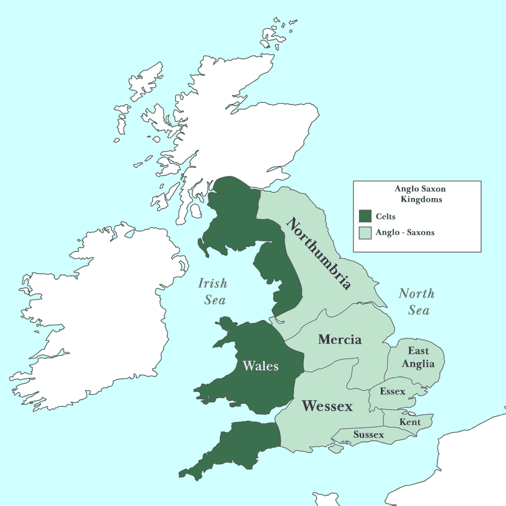
For most of the Dark Ages or early Middle Ages, “England” did not exist as a single kingdom at all. The island was carved into competing realms – Northumbria, Mercia, Wessex, East Anglia, Kent, Sussex, Essex – plus Celtic kingdoms in Wales and Cornwall and a shifting Norse presence in the north and east. Asking “who was the first king of England?” is like asking who was the first king of Europe: the answer depends on whether you care about borders on a map, titles on a charter, or raw political muscle.
By the 9th century, however, some Anglo‑Saxon rulers began to claim a wider authority than their home patch, styling themselves “bretwalda” or high king over other English rulers. This creates several plausible candidates for the “first king” label, which modern writers deploy depending on what story they want to tell: the heroic defender (Alfred), the forgotten conqueror (Egbert), the imperial organiser (Æthelstan), or even the Viking usurper (Cnut).
Egbert: the forgotten unifier before England
Long before Æthelstan, there was Egbert of Wessex, who reigned from 802 to 839 and spent much of his career methodically breaking rival kingdoms. Starting from his power base in the south‑west, he crushed Mercian power at the battle of Ellendun in 825, then moved on Kent, Sussex, Surrey and Essex, seeing their rulers submit and installing his own son as sub‑king. By 827 he had overawed or defeated Mercia and Northumbria as well, prompting later chroniclers to style him bretwalda – an over‑king of all the English south of the Humber at least.
Some modern writers, keen on a strong origin story, point to this moment and declare Egbert “the first king of a united England”, noting that his sway briefly covered all the main English territories. Yet that unity was fragile. Mercia slipped from his grasp the very next year, and Northumbria’s deference was more about prudently acknowledging the strongest warlord than admission into a single, permanent kingdom. Egbert’s achievement was enormous, but he created an English superpower centred on Wessex rather than a stable kingdom called “England”.
Alfred: the first English king?
Alfred the Great, ruling from 871 to 899, is often smuggled into this debate because of his later fame as saviour of the English from the Vikings. Late sources credit him with styling himself “king of the Anglo‑Saxons” and presenting the English as one people in the face of Scandinavian conquest, even though great swathes of the north and east were still under Viking rule. In this sense, some argue, Alfred was not king of England but the first consciously “English” king – the man who turned shared language and law into a political idea.
Yet on any hard map Alfred’s realm was incomplete. At his death, the “Danelaw” – the area of Norse control in eastern and northern England – remained outside his authority. Alfred laid the ideological and military foundations for future unity, but he did not live to see a single crown genuinely ruling all English lands.
Æthelstan: the first king of all the English
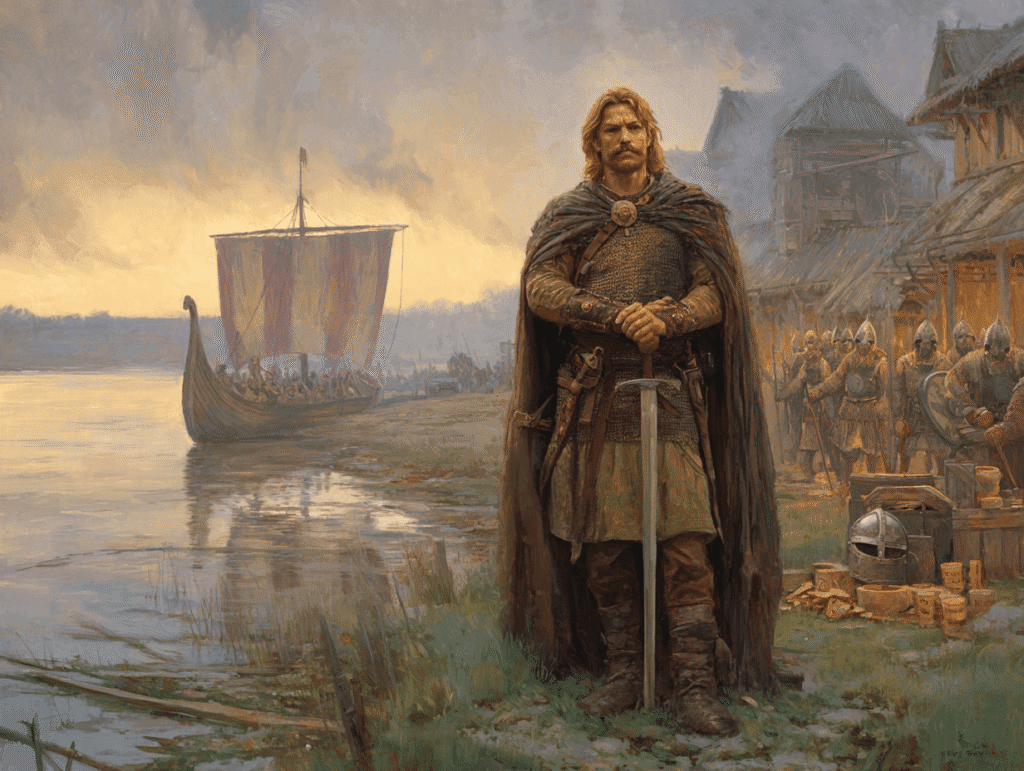
That brings us to Æthelstan, Alfred’s grandson, who reigned from 924 to 939 and is now widely regarded as the first true king of England. When he inherited Wessex and Mercia, he did not yet control the north, where the city of York and much of Northumbria lay under Scandinavian rule. Within a few years, however, he moved decisively: in 927 he seized York, subdued most of Northumbria, and crushed resistance in Cornwall, making English authority felt all the way to the far south‑west.
The scale of his dominance is striking. Æthelstan compelled five Welsh kings to pay him regular tribute and forced Constantine II of Scotland to acknowledge his overlordship. By 927 the other British rulers met at Eamont Bridge to recognise him as supreme, a scene later tradition remembered as the moment he truly became “king of the English”. For the first time, one ruler had not only conquered but held all the core English territories under a single crown.
It was under Æthelstan that we first see the title Rex Anglorum – “King of the English” – used consistently in official documents. A charter of 928 is the earliest known to describe him that way, and from Æthelstan through to King John this became the standard style. Later, the wording evolved toward “King of England”, but the crucial conceptual leap – that there was a single people, the English, with one king – dates to Æthelstan’s reign.
“King of the English” vs “King of England”
Part of the confusion comes from a seemingly tiny difference in phrasing: being king of the English versus king of England. Anglo‑Saxon rulers before Æthelstan sometimes claimed lordship over “the English” or “the Anglo‑Saxons”, but this often meant overlordship in a loose, personal sense rather than tightly defined territorial rule. Æthelstan’s charters, by contrast, accompany the phrase Rex Anglorum with clear evidence of control over the major English regions – Wessex, Mercia, Northumbria and the borderlands.
A later twist adds another candidate: Cnut, the Danish ruler who took the English crown in 1016, is the earliest monarch consistently recorded as using the Latin form “King of England” in the sense of Rex Angliae. If you define “first king of England” strictly by that exact wording, then Cnut, not a native Anglo‑Saxon at all, wins the prize. However, most historians consider this a technicality and still credit Æthelstan as the foundational king because the political reality of a united English kingdom was established under him, whatever the precise Latin formula.

Why Æthelstan’s claim matters most
What sets Æthelstan apart is not just that he won more battles or bullied more neighbours, but that under him the machinery of a single kingdom began to lock into place. He issued law codes aimed at the whole realm, not just a region, trying to standardise justice, control feuding and theft, and bind his subjects into one legal framework. He minted coinage that circulated across his territories, projecting a single royal image and reinforcing the idea that English lands formed one economic unit under one ruler.
His court became a magnet for Continental princes, clerics and scholars, enhancing the prestige of the new kingdom and tying it into wider European networks. Foreign observers admired his power, and modern scholarship has increasingly highlighted how central he was in making “England” a political fact rather than merely a geographic term. Yet his fame faded, partly eclipsed by his grandfather Alfred’s cult and partly because the later Norman conquerors preferred to minimise the sophistication of their Anglo‑Saxon predecessors.
Why some still argue for Egbert or others
Even with this strong case for Æthelstan, the debate has not entirely gone away. Writers who emphasise early‑9th‑century power politics still present Egbert as “the first king of a united England” because his sway, however briefly, covered most English‑speaking territories, and he was recognised as bretwalda over other kings. Others, focusing on national identity, point to Alfred as the first monarch to frame the English as a single people whose fate was bound together.
A few go further back, to Offa of Mercia in the late 8th century, who dominated much of southern England and corresponded on equal terms with Charlemagne, arguing that in practical terms he behaved like a “king of England” in all but name. And then there is Cnut, whose explicit use of “King of England” in his royal style has tempted some modern commentators to give him the title on a technical, diplomatic criterion.
This diversity of answers does not show that historians are being evasive; it reflects the fact that “England” itself was not born in a single dramatic moment. It coalesced over generations through conquest, law‑making, religious policy and narrative framing, so different scholars choose different points on that long slope as the decisive step.
So, who was the first king of England?
Put all of this together, and a nuanced answer looks like this:
- If you mean the first ruler to briefly dominate all the main English kingdoms: Egbert of Wessex in the 820s is a strong candidate.
- If you mean the first king to articulate a shared “English” identity under one crown: Alfred the Great has a serious claim.
- If you mean the first monarch to rule, in a sustained way, all the English territories with a coherent royal title and state‑like institutions: Æthelstan stands out.
- If you insist on the literal phrase “King of England” in the royal style: Cnut the Great is the first to fit that exact wording.
Among these, most modern historians and heritage organisations now present Æthelstan as the first king of England, because under him in the 920s and 930s the patchwork of Anglo‑Saxon and Scandinavian realms was first forged into a single, recognisable English kingdom ruled from one centre. Egbert, Alfred and Cnut remain crucial stepping‑stones in that story, but Æthelstan is the ruler who, more than any other, turns the question “who was the first king of England?” from an argument into a name.


Has to be Athelstan surely as king of what is recognisably England while Alfred was king of the English.
Athelstan was also acknowledged as Bretwalda by the Scots and the Irish.