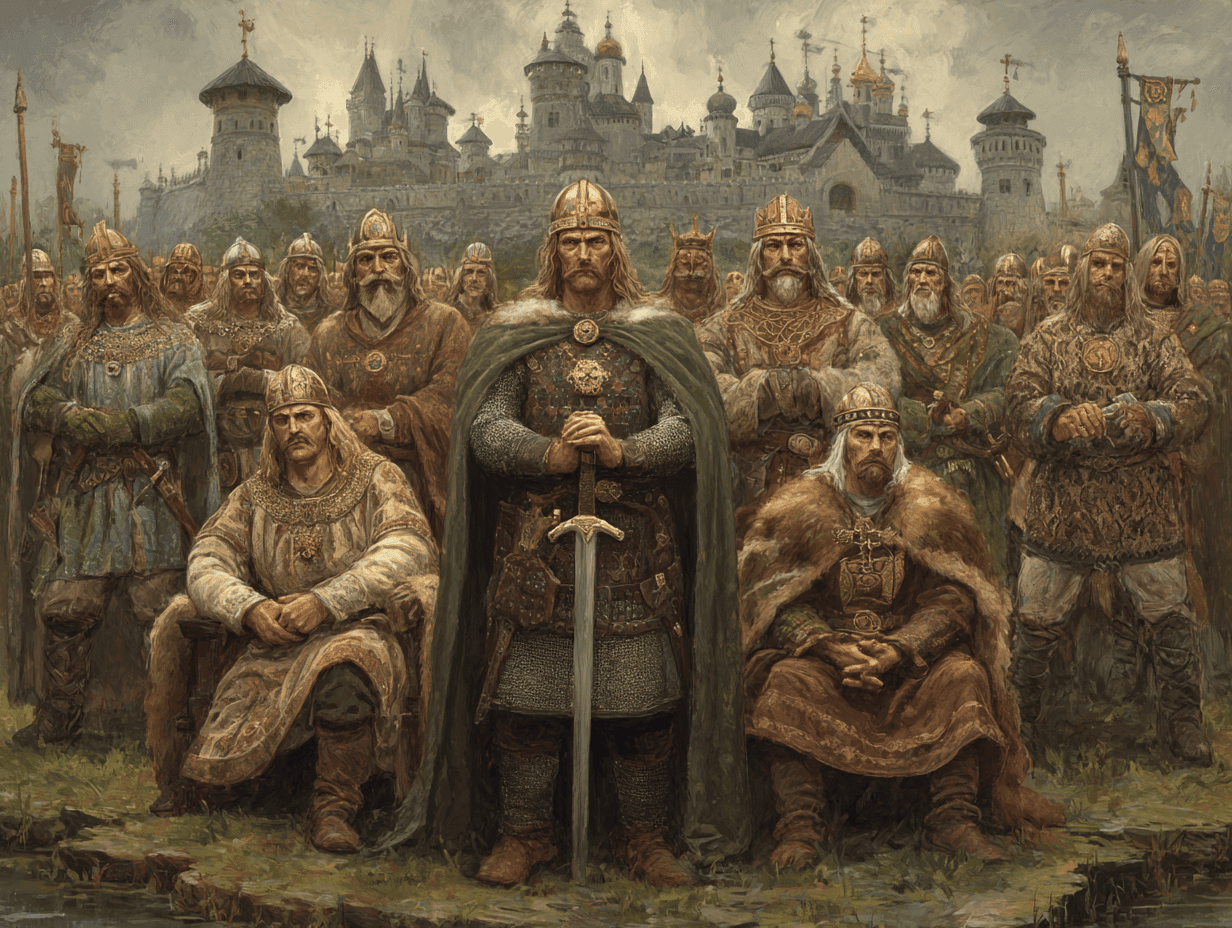
In the dying years of the 9th century, amid the mist-laden forests and riverways of early Rus’, a Viking prince named Rurik carved his name into the bedrock of Eastern European history – and then, almost as suddenly as he appeared, vanished into legend. The man who replaced him, the young Igor, stood at the threshold of both chaos and empire – a bridge between an age of raiders and one of rulers.
The World Rurik Inherited
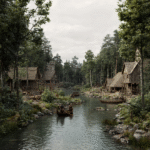
By the time Rurik’s longships glided into the lands around Lake Ilmen, the rivers of eastern Europe were already highways of ambition. The Dnieper, the Volkhov, and the Volkova carried not just trade goods but ideas and people: Norsemen from Scandinavia, Slavs from the south and west, Finno-Ugric tribes from the north, Greeks from Byzantium. The region was an untamed crossroads.
The “Rus’,” a term that likely came from a word for “rowers,” referred to the Scandinavian traders and warriors who had settled among the Slavs. They were part of the wider Viking diaspora that extended from Dublin to Baghdad, driven as much by commerce as by conquest. The riches of Byzantium glittered far to the south, and every chieftain with a crew and ambition dreamed of reaching them.
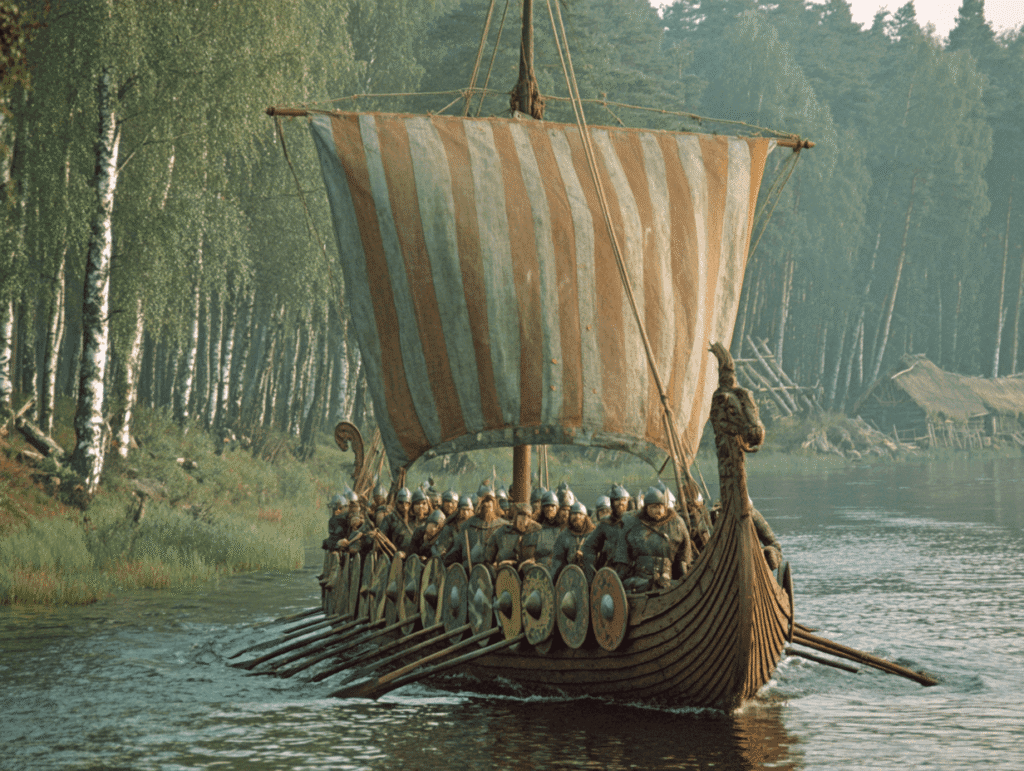
But life for the Rus’ of the north wasn’t a saga of endless plunder. The forests were deep, the winters cruel, and the locals often hostile. The Slavic tribes, weary of bloody squabbles, sought stability as much as protection. According to the Primary Chronicle, a foundational text compiled in Kiev two centuries later, these tribes invited Rurik and his “brothers” to rule and bring order: “Our land is great and rich, but there is no order in it. Come to rule and reign over us.”
Thus, around 862, Rurik and his Varangians entered the scene – though whether he was truly invited or simply took what he wanted remains a matter of debate.
The Enigmatic Rurik
Almost everything known about Rurik is filtered through haze and hearsay. The Primary Chronicle describes him arriving with his brothers Sineus and Truvor, who supposedly died soon after, leaving Rurik as the sole ruler based in Novgorod. There, on the banks of the Volkhov River, he established the first organized center of Rus’ power.
Who he actually was is another matter. Some historians suspect Rurik to have been Hrœrekr, a Danish or Swedish noble linked to the royal line of Uppsala or Jutland. Others think he may have been a military entrepreneur, a man hired by desperate Slavs to bring his sword and structure to their fractious lands.
Regardless, Rurik was no mere raider. He founded a network of armed outposts, oversaw tribute collection, and opened trade with both the Baltic and Byzantine worlds. In short, he began transforming a region of tribes into a state.
Forging the Rus’: Blood and Silver
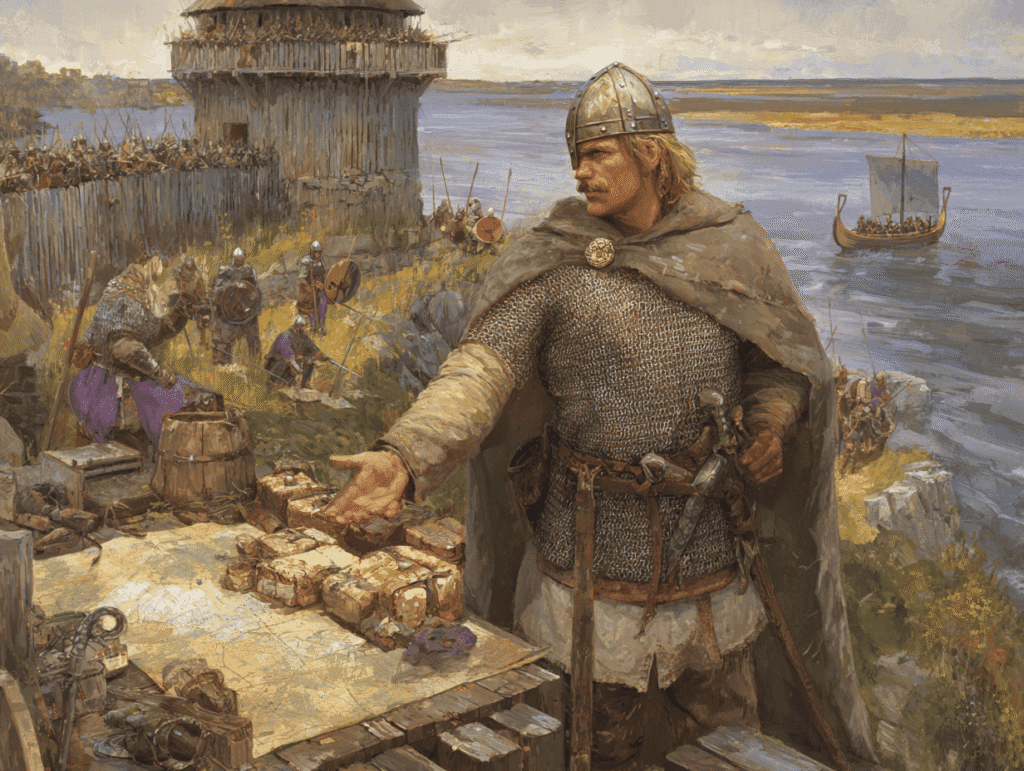
Rurik’s years in power were anything but peaceful. Consolidating rule meant enforcing it – a task that drew on both Viking ferocity and careful diplomacy.
The northern Slavs, particularly the Ilmen and Krivich tribes, accepted the Varangians with wary cooperation, exchanging furs and honey for iron tools, salt, and weapons. The Finno-Ugric tribes, meanwhile, paid tribute more grudgingly.
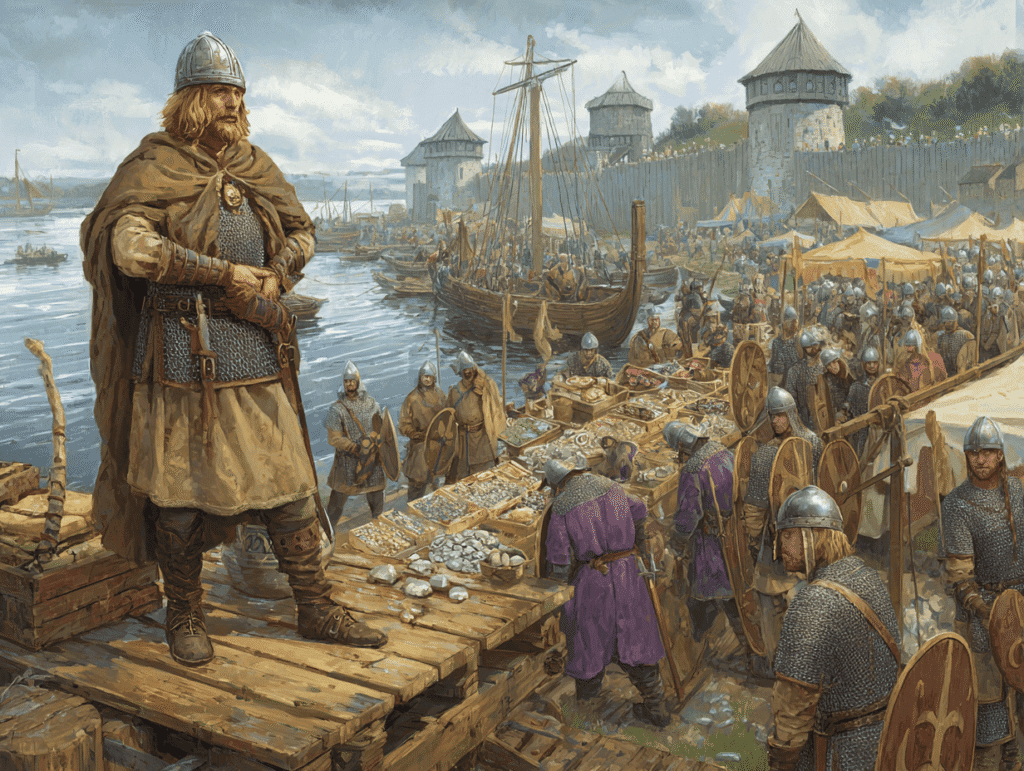
Novgorod grew under Rurik’s control, its wooden walls and trading quays bustling with men who spoke different tongues but shared a hunger for opportunity. Silver coins – dirhams from the Caliphate, pennies from the Frankish realm, and Byzantine nomismata – found their way up the river routes. Every ingot passing through Varangian hands was taxed, and every merchant who refused found that the Rus’ knew how to enforce understanding swiftly.
At the same time, Rurik’s authority rested on personal charisma and the constant threat of force. “King” may be too orderly a title for a ruler whose hold on power was measured by how many warriors would follow him into battle. But for a rough, volatile land just learning to trade blood for silver, Rurik was as close to a king as anyone had ever been.
The Stranger From the North Becomes a Patriarch
Even before his death, Rurik’s legend began to grow. He took a wife – her name uncertain, though later sources call her Efanda, perhaps of Scandinavian noble birth – and they produced a son, Igor. To the outside world, Igor was simply another Varangian child born on a cold riverbank. But in time, chroniclers would retroactively call him the heir of a dynasty destined to rule Kievan Rus’ and, later, all of Russia.
As the 870s waned, Rurik’s dominion stretched across the northern Rus’ heartland, linking Lake Ladoga, Novgorod, and the upper Volga. Yet power always brings challengers. In the south, near Smolensk and Kiev, other Norse adventurers had carved their own domains. Two, in particular, would soon change Igor’s fate: Askold and Dir.
Kiev and the Challenge of Askold and Dir
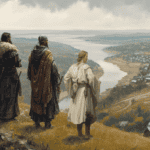
Askold and Dir were Varangian leaders who, according to the Chronicle, had sailed down the Dnieper and seized Kiev from local tribes. Their realm, smaller but strategically placed on the route “from the Varangians to the Greeks,” held the key to immense wealth. Whoever controlled Kiev controlled the rivers that joined the Baltic to the Black Sea — and thus the golden artery between the north and Byzantium.
Rurik likely viewed them as rivals, though the scant evidence leaves much to speculation. The Chronicle simply notes that Rurik “sent to Kiev his man Oleg, together with Igor his son,” implying a later conquest that probably began as an ambition under Rurik’s gaze.
Still, in 879, before his plans ripened, death came for the Viking prince.
Rurik’s Mysterious Exit
The sources are frustratingly brief: “And Rurik died, and he gave his realm to Oleg, of his kin, and committed his son Igor into Oleg’s care.” In these few lines lies one of the most consequential successions in medieval Europe.
How Rurik died is unknown. Some romantic chroniclers imagine a noble death, struck by illness or wounds after a lifetime of battle. Others suspect he simply succumbed to age and exhaustion. To his followers, he might have passed as kings are meant to — surrounded by weapons, men, and the smell of smoke. The sagas do not say.
What they do say is who followed: Oleg the Seer, Rurik’s kinsman, perhaps a brother-in-law or trusted captain. Oleg became regent for the infant Igor, a role that would transform him from mere adviser to empire-builder.
The Rise of Igor in the Shadow of Oleg
Imagine the scene in late 879: Novgorod encased in frost, warriors gathering to swear loyalty. In a wooden hall hung with shields, a young child — probably not older than three — is lifted high. Around him stand hard-eyed men of Scandinavian and Slavic descent, pledging to serve the new “son of Rurik.” Above them presides Oleg, whose ambitions already stretch far beyond the north.
In this moment, the Rus’ cease to be a confederation of settlements and begin to coalesce into a hereditary realm. For the first time, succession passes not to the strongest warrior but to kin by blood. That shift — subtle but profound — marks the birth of the Rurikid dynasty, which would rule until the 16th century.
But Igor’s early years would be lived entirely under Oleg’s shadow. For three decades, it was Oleg who wielded Rurik’s sword and banner, expanding the Rus’ dominion southward.
Oleg the Seer and the Fulfillment of Rurik’s Dream
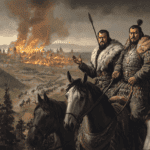
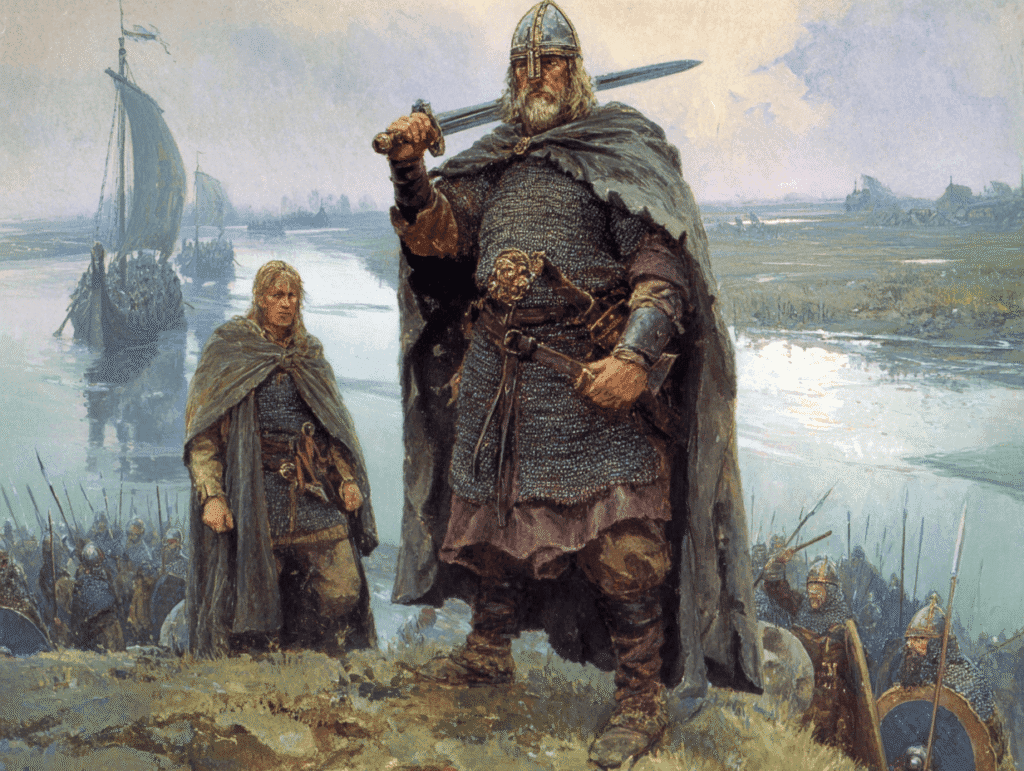
Oleg wasted no time asserting Rurikid authority. Around 882, he marched south with Igor and an army of Varangians and Slavs, conquering Smolensk, Lubich, and finally Kiev. There, by cunning or treachery, he killed Askold and Dir — fulfilling Rurik’s unfinished mission.
Announcing the city as the “Mother of Rus’ Cities,” Oleg transferred his seat of power from Novgorod to Kiev, uniting northern and southern Rus’ under one rule.
It’s tempting to imagine Rurik’s ghost smiling down at the achievement. He had begun a process that Oleg, acting as steward for the boy Igor, carried to fruition. The young heir grew up amid the campaigns that unified the Dnieper basin, learning statecraft and warfare from one of the most formidable chieftains of the age.
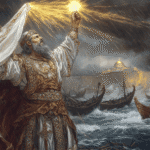
Oleg’s raids against Constantinople — including the famous 907 campaign when he nailed his shield to the city’s gates — became the stuff of legend. Whether myth or history, these deeds established Igor’s future as heir to a warrior realm recognized from the Volga to the Bosporus.
The Making of a Dynasty
When Oleg eventually died, sometime around 912, Igor was ready. The child who had once been carried on the shoulders of Rurik’s men now ruled in his own right. The transition was serene by Viking standards, suggesting that Rurik’s bloodline, sanctified by years of success, now commanded real legitimacy among the warriors and tribes.
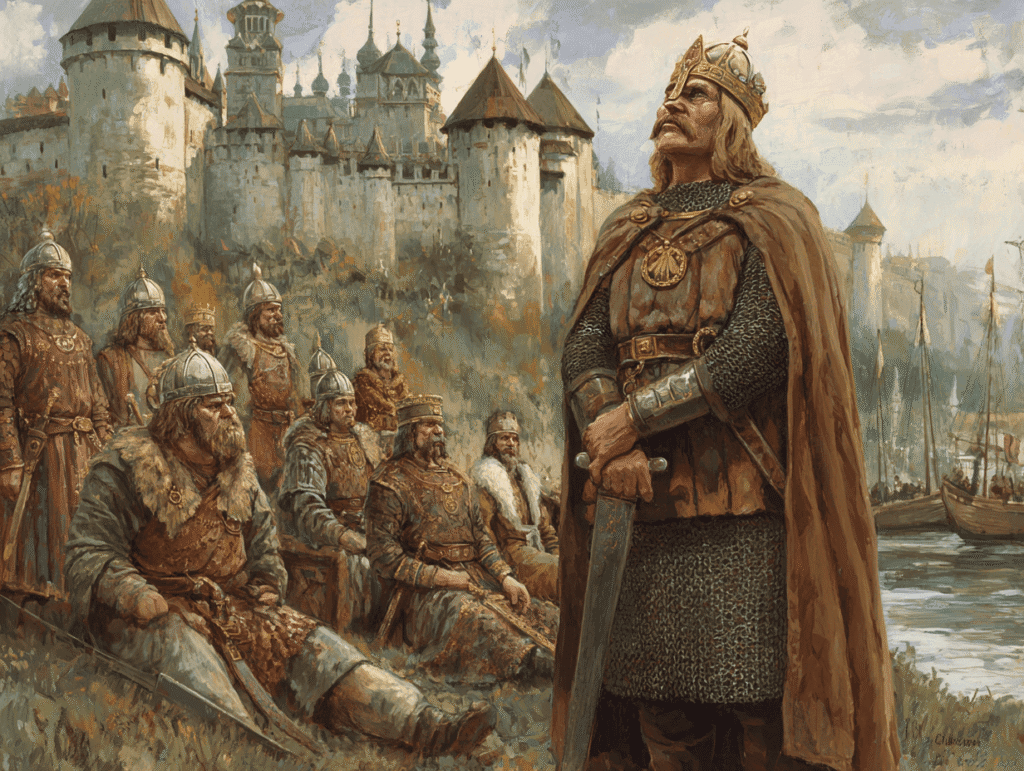
Through Igor, the Rurikid line became something larger than a man’s legacy — it became destiny. Over the next centuries, his descendants would populate thrones and courts across Eastern Europe, from Kiev to Moscow, Novgorod to Suzdal. Even the later Tsars of Russia, centuries removed from Varangian accents, would claim descent from Rurik’s iron hand.
The dynasty he began outlived empires, religions, and invasions. Its roots — in violence, pragmatism, and ambition — were unmistakably Norse. Yet over time, it absorbed the Slavic soul of its lands, blending two worlds into something entirely new.
Legend versus Reality
Historians have long wrestled with what part of Rurik’s story is truth and what is carefully constructed myth. The so-called Normanist Controversy that raged for centuries in Russian and Soviet academia revolved around this question: were the founders of Rus’ foreign conquerors or native leaders?
Normanists (mainly Western scholars) argue that Rurik and his Varangians were clearly Norsemen who imposed political order on the Slavic tribes. Anti-Normanists, on the other hand, see Rurik as either a Slavicized leader or even a symbolic figure invented by later chroniclers to give the Rus’ a noble, organized beginning.
Modern research, blending archaeology with linguistics, leans toward a middle road: Rurik and his companions were indeed of Scandinavian origin, but they quickly intermarried, assimilated, and ruled in alliance with the local elites. They were not outsiders so much as catalysts — men who transformed a region ready for unification.
Artifacts from Ladoga, Novgorod, and Kiev show clear trade links with the Norse world, alongside evidence of Slavic cultural fusion: Scandinavian swords beside Slavic pottery, runic inscriptions beside Byzantine coins. In these finds, the boundaries between Rurik’s homeland and his adopted kingdom blur into something distinctly Rus’.
A Founder Remembered
When later Kievan princes sought to legitimize their authority, they turned always to Rurik. He became less a man and more a founding myth — the Viking who had come, ruled wisely, and left a kingdom to his heirs. Monks writing under Christian rulers centuries later softened his pagan roughness, painting him as a noble bringer of order.
Even in modern Russia, his name still carries weight. The Rurikid dynasty is recognized as the first royal house, ancestral to both medieval princes and, indirectly, the Romanovs who replaced their line in the 17th century. For many Russians, Rurik stands beside the likes of Alfred the Great and Charlemagne — the archetypal founder who shaped a fractured people into a nation.
Beyond Death: The Legacy of a Viking Prince
Rurik’s death in 879 was an ending only in name. In truth, it was the spark that ignited an epoch. The system he forged — grounded in the exchange of loyalty for protection, of silver for sword — became the DNA of early Russian governance. His model of princely rule through kinship and tribute would echo in Slavic politics for centuries.
Under Igor, and later Igor’s wife Olga and their son Sviatoslav, the realm grew into a major power, trading and fighting with Byzantium, the Khazars, and the Pechenegs. Each expansion, each treaty, each baptism of faith could trace its lineage to the moment when a weary Viking accepted rule over the Slavic tribes.
It is tempting to view Rurik’s story as a classic Viking arc — a seaborne wanderer who seizes glory and dies young. Yet his true genius lay in something subtler: he knew when to stop raiding and start ruling. His legacy was not measured in loot, but in lineage. That is far rarer among Vikings than battle trophies.
And perhaps that is why history remembers him while countless sword-brothers’ names have vanished into the mist.
A Dynasty’s Reflection
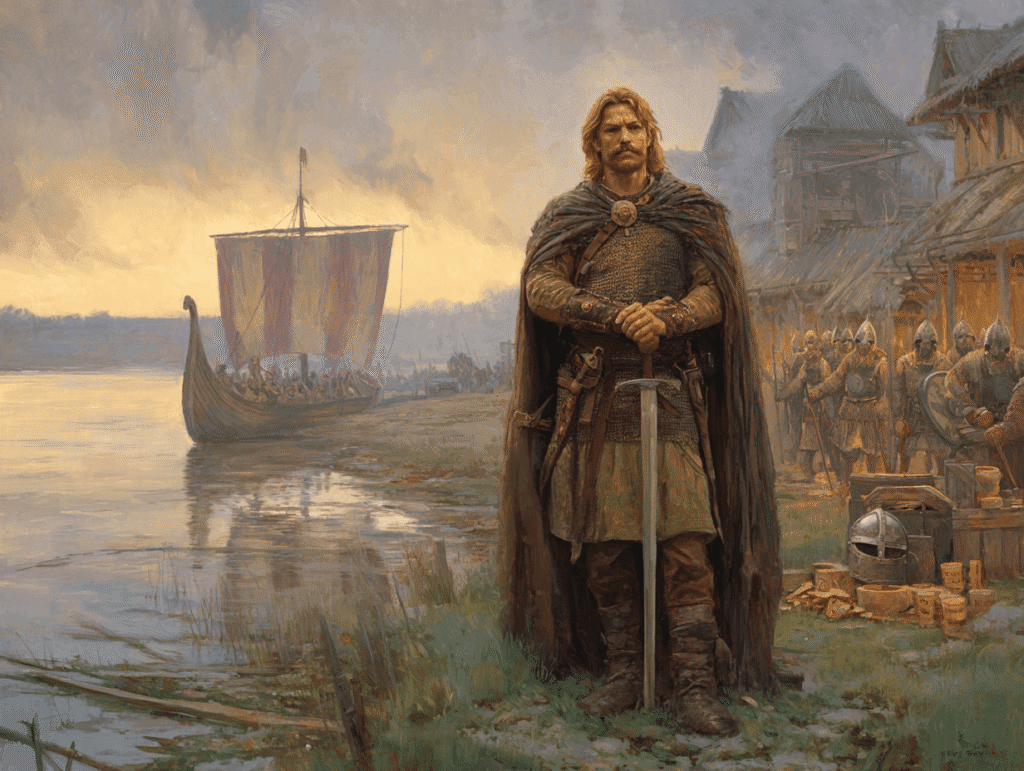
In the centuries that followed, poets would trace the line of Rurik through Igor and onward to Yaroslav the Wise, Vladimir the Great, and beyond. Each prince could look back and see in their founder a reflection of themselves: part barbarian, part statesman, always ambitious.
Even the Mongol invasions, which shattered the Kievan state in the 13th century, could not erase the idea of the Rurikid line. Branches survived in Novgorod, Suzdal, and later Moscow, preserving a faint ember of that Viking flame. When Ivan III married into the last Byzantine imperial family and began calling himself Tsar, he did so as a Rurikid — a descendant of the northman who had once ruled from Novgorod’s wooden fortress.
The threads of Rurik’s lineage continued even into modern history. Dozens of noble families across Eastern Europe, from the Šuiskys of Lithuania to the Romanoviches of Moscow, claimed descent from his bloodline. His dynasty, born in a frontier chieftain’s hall, became one of the longest-lived in the world.
The Death That Founded an Empire
Rurik’s death in 879, obscure and understated in the chronicles, marked the rarest kind of historical passing — one that signals birth rather than decay. His exit cleared the stage for Oleg’s consolidations, Igor’s inheritance, and the empire that would follow. By dying, he became immortal.
Imagine, for a moment, the scene on that winter’s night: Rurik’s household gathered around, warriors kneeling, the flicker of torches on bronze rivets. Outside, snow hushes the forest. He names Oleg guardian of his realm and his son. Then, as legend has it, he closes his eyes — a Viking who had long since traded the sea for sovereignty.
In that silence, a dynasty began breathing.
Centuries later, historians would still be chasing the faint footprints he left between history and myth. But perhaps that was Rurik’s greatest triumph: not just founding a kingdom, but becoming its legend.