When people hear the name William the Conqueror, they usually picture a warrior king: armoured knights, Norman castles, the invasion fleet crossing the Channel, and the bloody struggle that culminated at Hastings in 1066. Yet behind William stood a woman whose story is every bit as fascinating – and considerably less well known. Her name was Matilda of Flanders.
Born into one of the most powerful families of eleventh-century Europe, Matilda became the wife of William, Duke of Normandy, and eventually Queen of England. She was the mother of kings, a political player in her own right, a patron of religion and culture, and a woman who appears to have possessed considerably more influence than the traditional image of a medieval queen might suggest. Her life also crossed one of the great turning points in European history.
She married William before he became King of England, supported him during the dangerous years of his conquest, and helped govern Normandy while he fought to establish his authority in England. She later travelled to England to be crowned queen and became an important figure at the centre of the new Anglo-Norman monarchy. And yet, compared with her famous husband, Matilda often survives in history as little more than a footnote.
That is a mistake. Her story reveals something fascinating about medieval power: conquest might be won on a battlefield, but kingdoms were held together through marriage, inheritance, diplomacy, religion, administration and family. Matilda understood that world extraordinarily well.
A Princess Born Into Power
Matilda was born around 1031, probably in Flanders (now Belgium). She was the daughter of Baldwin V, Count of Flanders, and Adela of France, herself the daughter of the French king Robert II. This was an exceptionally prestigious family.
Flanders occupied a strategically important position in northern Europe. Its territory sat between the emerging kingdoms of France and the Holy Roman Empire, while its ports and towns were increasingly connected to the commercial networks of northern Europe. Matilda therefore did not grow up in an insignificant provincial court. She was raised in a world of dynastic politics, where marriages were rarely simply about love. They could determine alliances, secure territories and transform the fortunes of entire families.
For a young aristocratic woman, marriage could be one of the most important political decisions of her life. Matilda’s future husband would prove to be one of the most controversial men in medieval Europe. His name was William.
The Duke With a Dangerous Reputation
William was born around 1028 and became Duke of Normandy as a child. His position was precarious. Although he was the son of Duke Robert I of Normandy, his legitimacy was questioned because his mother, Herleva, was not a noblewoman. William’s enemies later exploited his illegitimate birth as a political weapon, but he nevertheless survived a remarkably dangerous childhood and gradually established his authority.
By the time Matilda was old enough to marry, William was an ambitious and formidable ruler. But there was a problem: Matilda apparently did not initially want him. Later tradition tells a dramatic story about their courtship. According to one version, William became so determined to marry Matilda that he confronted her personally after she rejected him. The story claims that he seized her, threw her from her horse, or even beat her.
Whether this actually happened is impossible to establish. The tale was recorded much later, and medieval chroniclers loved dramatic stories about powerful rulers. Nevertheless, the story has survived because it fits a broader truth about the marriage: this was a politically significant match between two powerful dynasties.
Eventually, Matilda agreed to marry William. The exact date is debated, but their marriage took place around 1051 or 1052. It would become one of the most consequential marriages in European history.
A Marriage That Almost Caused a Crisis
There was, however, an immediate complication. The Church objected to the marriage because William and Matilda were considered too closely related by the standards of medieval canon law. Their relationship was distant by modern standards, but medieval rules concerning consanguinity could be extremely restrictive, particularly among the ruling elite, where marriages between aristocratic families frequently produced complicated webs of kinship.
The papacy eventually became involved, and the couple received permission to remain married after fulfilling religious requirements, traditionally said to have included founding religious institutions. Whatever the exact details, the marriage survived, and Matilda and William would go on to have a large family, probably producing at least nine children who survived infancy.
Among their sons were Robert Curthose, William Rufus, and Henry, who would eventually become King Henry I of England. Their daughters also became important figures in European dynastic politics. Matilda was therefore not merely the wife of a conqueror. She was the mother of a dynasty.
The Duchess of Normandy
For much of their early marriage, William and Matilda ruled Normandy, and this is where Matilda’s political importance begins to emerge. Medieval women of the ruling class were not necessarily powerless figures hidden away in castles. Queens and noblewomen could own property, administer estates, supervise households, patronise religious institutions, act as intermediaries, and participate in diplomacy.
Matilda appears to have played many of these roles. She also became closely associated with the administration of Normandy while William was absent. This was particularly important because William’s life was rarely peaceful. Normandy faced internal opposition, disputes with neighbouring rulers and threats from powerful aristocratic families. William needed to campaign, while Matilda needed to help maintain stability at home.
The division of responsibilities was not necessarily formal in the modern sense, but it could be politically crucial. William could leave Normandy knowing that his wife represented the ruling dynasty. Matilda, meanwhile, had to manage the responsibilities of being duchess in a world where aristocratic power was constantly contested.
Her position also gave her enormous dynastic importance. A marriage between William and Matilda linked Normandy with Flanders, while their children connected the Norman ruling family with other aristocratic houses across Europe. Marriage was diplomacy, children were alliances, and Matilda stood at the centre of both.
Then Came 1066
Everything changed in 1066. When Edward the Confessor, King of England, died without a surviving child, a succession crisis erupted. Several men had competing claims or connections to the English throne. Harold Godwinson, the powerful Earl of Wessex, became king, but William of Normandy claimed that Edward had promised him the crown and that Harold had previously sworn to support his claim.
William decided to invade.
Preparing an invasion fleet was an enormous undertaking. Ships had to be built or assembled, horses had to be transported, food and weapons had to be gathered, and thousands of men had to be organised. According to later tradition, Matilda played a remarkable role. She is said to have commissioned or provided a magnificent ship for William’s invasion fleet – the Mora – which supposedly led the Norman fleet across the Channel.
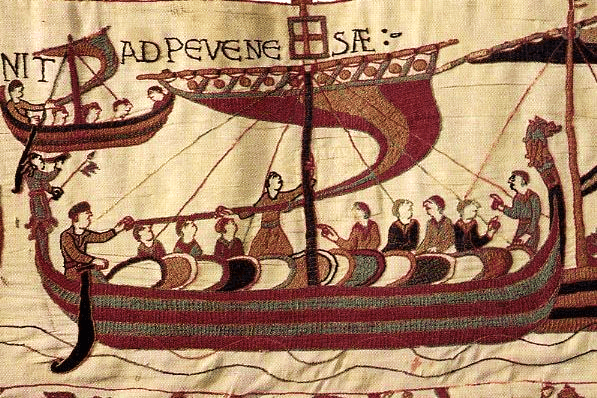
The details are debated, and it is uncertain whether Matilda personally financed every aspect of the ship. What is much clearer is that she remained an important part of the political and logistical world surrounding William’s invasion. William crossed to England, while Matilda stayed behind.
That decision tells us something important. William was going to war, but Matilda had a country to help govern.
The Woman Left Behind
The Norman invasion of England is one of the most famous military campaigns in European history. William landed in England, marched across the country and met Harold’s army near Hastings. On 14 October 1066, the two armies fought, Harold was killed, and William won.
But victory at Hastings did not immediately mean William controlled England. Resistance continued. William had to fight and negotiate his way through a country he barely knew. Castles were constructed, rebellions erupted, and Norman rule was challenged repeatedly.
While William was dealing with England, Matilda remained in Normandy. Her role was crucial because a medieval ruler could not simply abandon one territory while conquering another. Taxes needed to be collected, disputes needed to be settled, aristocrats needed to be managed, and the ruling family’s interests needed to be protected.
Matilda provided continuity. Her authority was also useful symbolically. She was not simply a wife waiting for her husband to return. She was the duchess of Normandy and the mother of William’s heirs.
Becoming Queen of England
William was crowned king of England on Christmas Day 1066 at Westminster Abbey. Matilda did not immediately become queen in the same ceremony. She was crowned later, at Westminster, on 11 May 1068.
Her coronation was politically significant. William’s conquest had created a new ruling dynasty, but the Normans still needed to establish legitimacy. Matilda’s coronation helped present the new monarchy as something more than the product of military conquest.
She was an aristocrat of impeccable European pedigree, descended from the rulers of France and connected to the powerful counts of Flanders. Her presence helped link the new English royal family to the established aristocratic order of continental Europe. She also became one of the earliest queens of England whose coronation is securely documented.
A Queen With Her Own Household
Matilda also possessed something that should not be overlooked: resources of her own. Medieval queens could control lands, income and households separate from those of their husbands. Matilda’s property and wealth gave her a degree of independence, while she also maintained her own court and participated in religious patronage.
One of the most famous examples of her cultural legacy is the Bayeux Tapestry. The tapestry tells the story of the events leading up to the Norman conquest of England, culminating in the Battle of Hastings. For centuries, tradition associated the tapestry with Matilda and her women.
Modern historians are more cautious. There is no firm evidence proving that Matilda herself commissioned the tapestry or that it was literally embroidered by her ladies. Nevertheless, its connection with the Norman ruling family is strong, and Matilda’s court existed within precisely the world that produced such monumental works of art and political storytelling.
Whether she personally ordered the tapestry or not, the work illustrates the culture of the dynasty she helped establish.
The Queen Who Became a Diplomat
One of Matilda’s most intriguing roles was that of intermediary. William was frequently away from England, and the kingdom was restless. Rebellions were common, and in such circumstances the queen could act as a bridge between the king, the aristocracy, the Church and the royal family.
Matilda also maintained strong connections with Normandy. Her position allowed the Anglo-Norman ruling family to remain connected across the Channel. This was vital because William did not think of England and Normandy as completely separate worlds. He was Duke of Normandy and King of England, and his power depended on maintaining both.
Matilda’s role helped make that possible.
Mother of Kings
Perhaps Matilda’s greatest political achievement was one she could not fully appreciate during her lifetime: the dynasty created through her children. Her eldest surviving son, Robert Curthose, inherited Normandy. Another son, William Rufus, became King William II of England. Her youngest son, Henry, became King Henry I.
This meant that Matilda became the mother of three rulers who shaped the future of Normandy and England. Her daughters were equally valuable to the dynasty. They were married into powerful European families, extending Norman influence across the continent.
In the medieval world, this was one of the greatest forms of political power available to a royal mother. Her children became diplomatic connections, her grandchildren would continue the dynasty, and her descendants would eventually shape the royal families of Europe for centuries.
But Was Matilda Really Powerful?
It is tempting to turn Matilda into a modern feminist heroine, imagining her secretly directing William’s conquest from behind the scenes. The evidence does not support such a simple story. Matilda did not command the Norman army at Hastings, and she did not conquer England. William was unquestionably the dominant military and political figure in the conquest.
But the opposite extreme – portraying Matilda as merely a passive wife – is equally misleading.
Her influence operated differently. She represented dynastic continuity, governed in William’s absence, controlled resources, participated in religious patronage, helped maintain connections between Normandy and England, and raised the children who would inherit enormous political power.
In other words, Matilda exercised the kind of authority that medieval queens could exercise. It was not always spectacular, and it did not necessarily produce dramatic battlefield victories, but it mattered.
The Marriage That Survived Power
Another remarkable aspect of Matilda and William’s relationship is that their marriage appears to have survived the enormous pressures placed upon it. William spent long periods away from Matilda, fought wars, governed England, and faced rebellions. Yet Matilda remained his wife and political partner for more than three decades.
They were not immune to family conflict. Like almost every medieval royal family, theirs became complicated. Their eldest son Robert eventually rebelled against William, and the conflict between father and son became serious.
Matilda apparently supported Robert financially, something that reportedly angered William. This episode is particularly revealing because it suggests that Matilda’s loyalties did not always align perfectly with those of her husband. She was not simply an extension of William’s authority. She was also a mother protecting the interests of her children.
That tension between wife, mother and political actor would become one of the defining features of medieval queenship.
The Founding of Holy Trinity
Matilda’s religious patronage left a lasting mark. In 1061, she founded the Abbey of the Holy Trinity in Caen, often known as Abbaye aux Dames. William founded the corresponding Abbey of Saint-Étienne, or Abbaye aux Hommes.
These institutions became major centres of religious life and monuments to the Norman dynasty. Matilda’s abbey was particularly significant because it reflected her personal status and religious interests. The church became closely associated with her memory, and when she died, she was buried there.
Her Final Years
Matilda’s later life was marked by the growing tensions within her family. William’s sons competed for influence and inheritance, while the future of Normandy and England was becoming increasingly uncertain. Matilda remained an important figure, but her health eventually declined.
She died in 1083, probably in November, at Caen, and was buried at the Abbey of the Holy Trinity. William survived her by only a few years, dying in 1087.

Their marriage had lasted roughly three decades. Together they had transformed the political landscape of England and Normandy, but their greatest impact would come after their deaths. Their children and grandchildren would continue fighting, ruling, marrying and reshaping the political map of western Europe.
The Queen History Almost Forgot
Why, then, is Matilda so often overshadowed? The answer is partly obvious. William conquered England. That is an event historians can describe through battles, armies, castles and political upheaval. Matilda’s achievements were quieter. She administered, negotiated, patronised, raised children, represented a dynasty and maintained connections.
These activities are less dramatic than the charge of an army across a battlefield, but they were fundamental to the survival of medieval kingdoms.
There is also a broader problem in how history has traditionally been written. Women who exercised power through households, family networks, patronage and diplomacy have often been treated as secondary characters. Their husbands appear in the main story, while their wives appear in the margins.
Yet in Matilda’s case, removing her from the story leaves a major gap. Without understanding Matilda, it is harder to understand how the Norman ruling family maintained its power across the Channel.
When William crossed the Channel in 1066, he went in search of a crown. Matilda stayed behind to protect the world that made his ambition possible. And when the dust of Hastings settled, it was not simply William’s victory that changed history. It was the beginning of a dynasty – a dynasty that Matilda helped create, a dynasty that her children carried forward, and a dynasty whose descendants would leave their mark on the history of England and Europe for centuries to come.
So perhaps the most revealing way to remember Matilda of Flanders is not simply as the woman behind William the Conqueror. She was something more complicated: a ruler in her own right, a political intermediary, a duchess, a queen, a patron, a mother and the architect – alongside William – of a royal family whose influence would reach far beyond their lifetimes.
William won a kingdom. Matilda helped make it a dynasty.