Ireland became the scholarship capital of the western Christian world because it preserved learning when much of post-Roman Europe was politically unstable, it built a dense monastic network that valued study, and it turned scholarship into a religious and cultural prestige project. In the centuries after Rome’s collapse, Irish monasteries produced scholars, manuscripts, missionaries, and schools that influenced Britain and Continental Europe far beyond the island’s size.
Why Ireland mattered
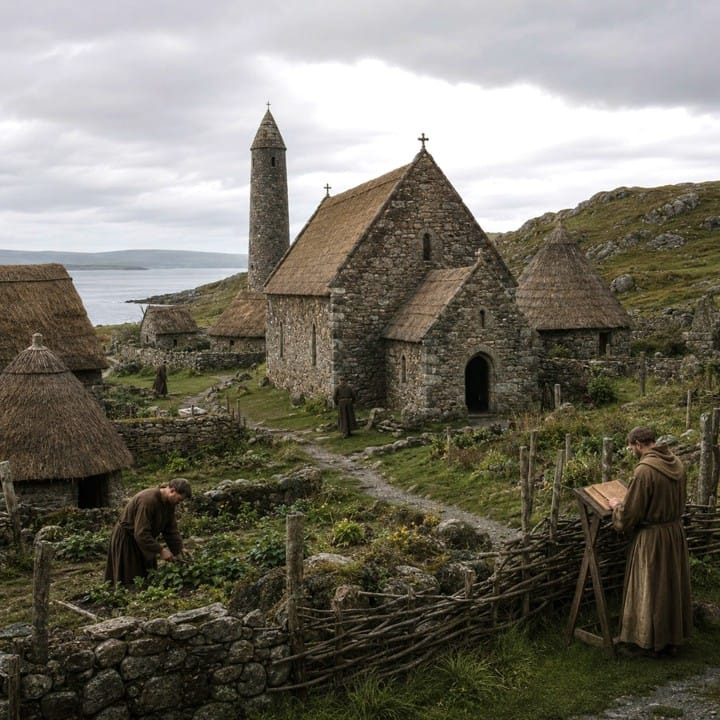
In the Dark Ages, Ireland having avoided being incorporated into the Roman Empire, was thus able to sit outside the worst of the imperial breakdown that swept across much of western Europe. That did not make life peaceful or simple, but it did mean Irish Christian culture developed in a distinctive setting, with strong monasteries rather than urban bishoprics as its main centers of learning. Those monasteries became places where Latin literacy, biblical study, theology, poetry, law, and manuscript production flourished together.
Ireland’s later reputation as the “Island of Saints and Scholars” captures this perfectly: holiness and learning reinforced one another. Monastic life was not just about prayer. It was also about reading, copying, interpreting, and teaching texts. That intellectual culture gave Ireland an outsized role in preserving and transmitting knowledge during a period when many other parts of western Europe were struggling to maintain educational continuity.

Monasteries as schools
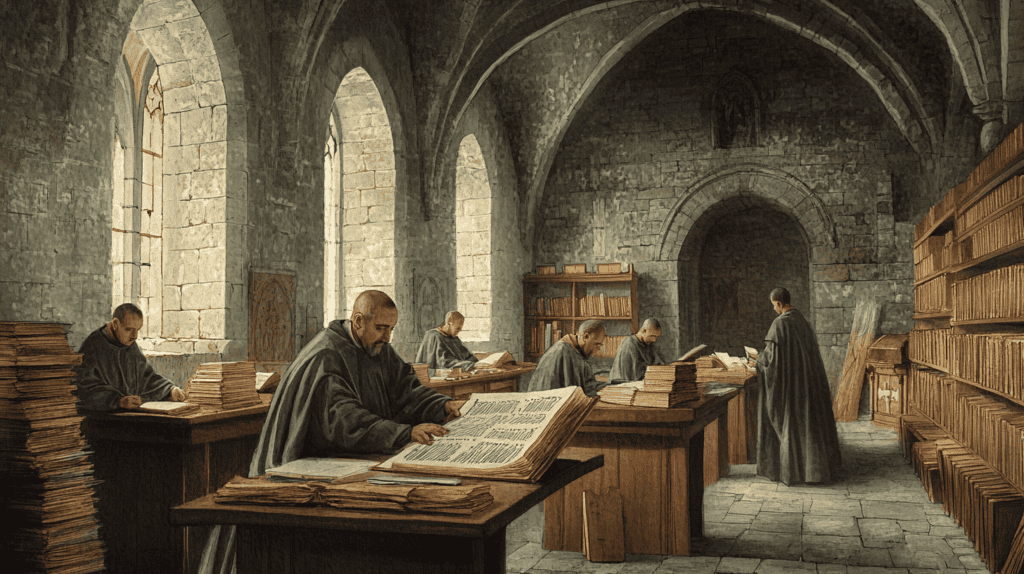
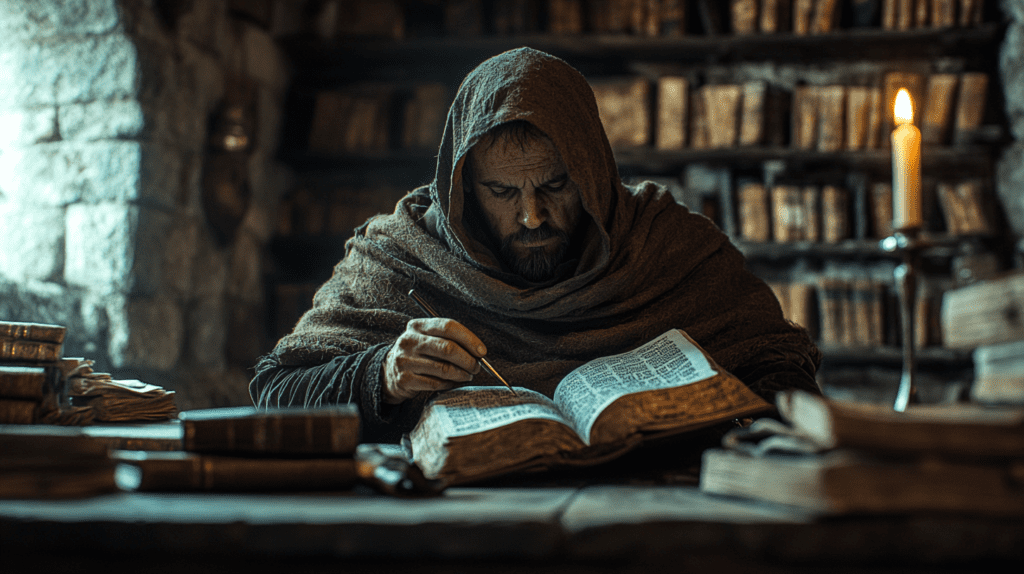
The great engines of Irish learning were monasteries. These institutions functioned as religious communities, libraries, scriptoria, schools, and centers of local influence all at once. Because monks and clerics needed Latin for worship and study, they became custodians of literacy in a world where written culture was otherwise limited. The result was a society in which educated religious communities could produce both spiritual and intellectual prestige.
This mattered because monasteries were not isolated retreats. They were connected by networks of travel, patronage, and shared texts. Irish monks studied one another’s work, copied manuscripts, and carried books and ideas across seas and borders. In practical terms, that meant Ireland was not intellectually provincial; it was plugged into the wider Christian world while still developing a distinctive style of scholarship.
A culture of learning
Irish scholars became known for more than piety. They contributed to theology, history, poetry, grammar, and canon law, building a reputation for serious intellectual work. The Irish monastic tradition valued not just memorization but careful textual study, commentary, and preservation. That made Irish scholars especially important in an era when books were precious and literacy was concentrated among elites.
The island’s scholarly prestige grew because learning was treated as a form of devotion. To study scripture, copy books, and master Latin was itself an act of religious discipline. That created a powerful incentive to maintain educational standards. A monastery that produced learned monks did not just gain internal respect; it gained status in the broader Christian world. Learning became part of Ireland’s spiritual identity.
Missionaries and influence abroad
Ireland’s influence expanded dramatically because Irish scholars and monks traveled. They did not keep learning confined to the island. Instead, they helped spread Christianity and learning to Britain and continental Europe, carrying books, ideas, and methods with them. This missionary movement turned Irish scholarship into an export.
That outward movement is one of the main reasons Ireland punched so far above its weight. A small island can become culturally influential when its educated elite travels well. Irish monks founded or influenced monasteries abroad, especially in areas where reform and renewal were needed. Their presence gave Irish learning a European footprint rather than a purely local one.
Why the reputation stuck
Ireland’s reputation as a center of scholarship was not accidental propaganda. It emerged from a real pattern of manuscript production, monastic education, and intellectual activity that stood out in the early medieval west. The island’s religious institutions served as hubs of learning while much of Europe was dealing with fragmentation and instability.
That does not mean Ireland was alone in preserving knowledge. Byzantium, parts of Italy, and some Frankish centers also remained intellectually active. But Ireland’s combination of monastic density, literacy, missionary energy, and cultural prestige made it exceptional. Over time, that helped cement the image of Ireland as a place where saints and scholars together shaped the Christian world.
Put simply, Ireland became the scholarship capital of the West because its monasteries turned religion into education, and education into influence.