For generations, the early Middle Ages have been saddled with a misleading label: the “Dark Ages.” The phrase suggests a continent in intellectual eclipse, a world of collapsing cities, crude warriors, and cultural silence. Yet when we look more closely, the period between roughly 500 and 1000 CE was not culturally empty at all. It was a time when a new and highly influential court culture emerged across Europe, one that shaped politics, literature, ceremony, art, learning, and power itself. Far from being dark, the age was full of glittering halls, sacred kingship, rival elite cultures, and sophisticated ideas about status and authority.
Court culture grew out of the ruins of the Roman world, but it was not merely a pale imitation of Rome. It was something new: a political and cultural system built around the king’s household, the display of authority, and the constant negotiation of loyalty. In the courts of the Franks, Anglo-Saxons, Visigoths, Lombards, Carolingians, Byzantines, and others, rulers did not simply govern. They staged power. They gathered poets, clerics, scribes, warriors, diplomats, and nobles around them, creating miniature worlds of hierarchy and ambition.
From Empire to Household
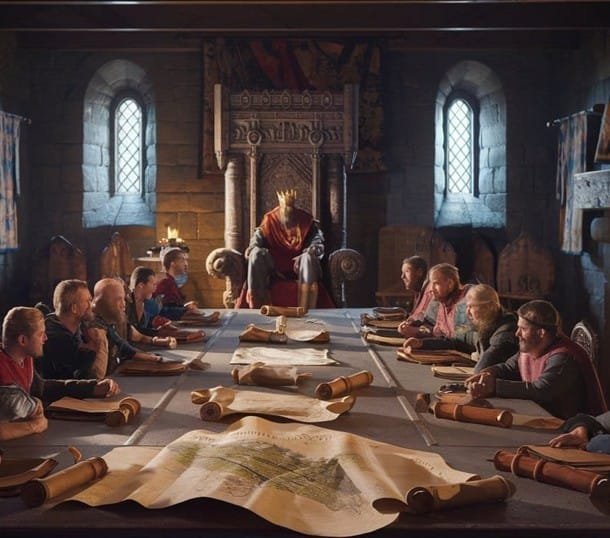
When Roman imperial structures weakened in the West, power did not disappear. It changed shape. Large bureaucratic states gave way to smaller kingdoms, and with them came new centers of authority. The royal court became the heart of politics because it was where decisions were made, gifts were distributed, alliances were forged, and status was displayed. In a world where kings often traveled with their households, the court was not always a fixed palace in the later medieval sense. It could move from one residence to another, bringing power with it.
This itinerant character mattered. A court was not just a building; it was a social organism. The king’s companions, household officers, clergy, guards, servants, and visiting nobles all formed part of its life. Around the ruler gathered people who could advise, flatter, challenge, entertain, and influence. The court was a stage, but it was also an arena of competition. Proximity to the ruler meant power, and everyone knew it.
Power as performance
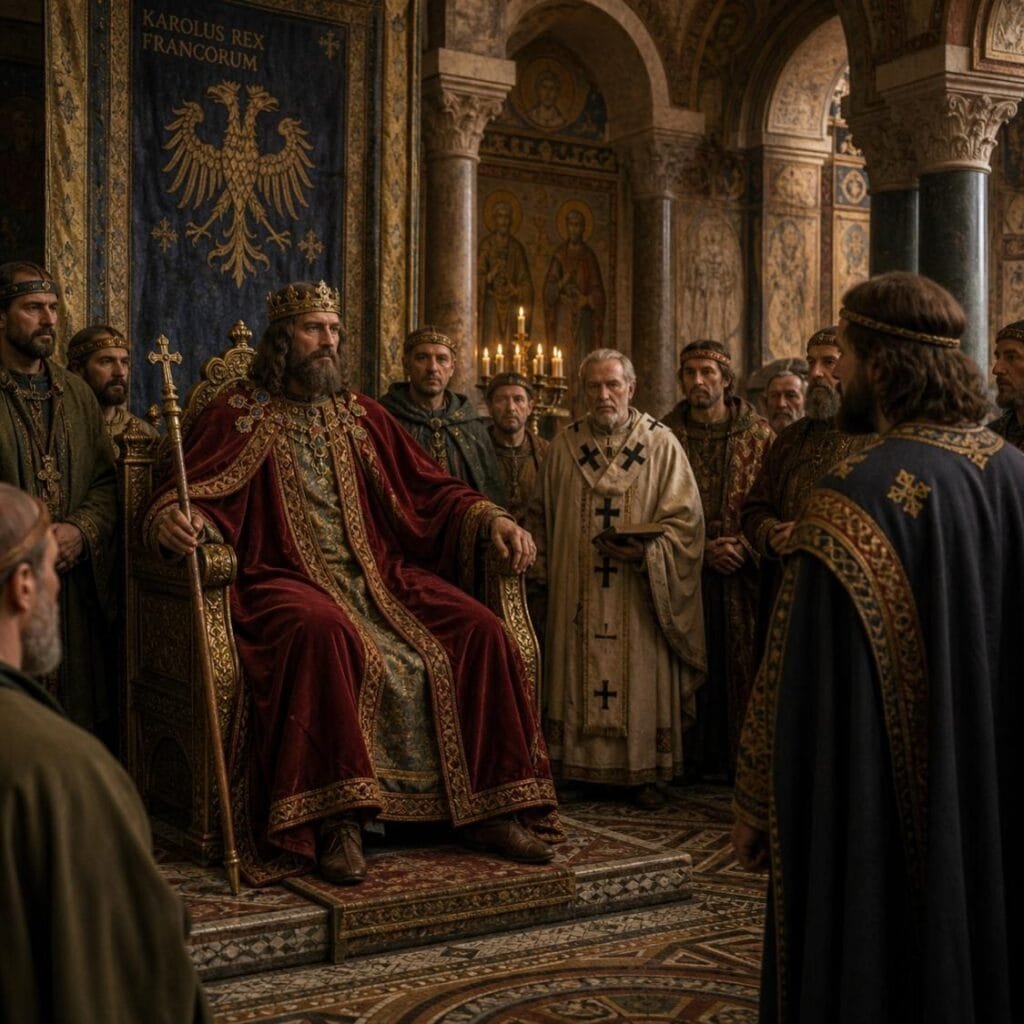
In the early medieval world, authority had to be seen to be believed. Kings could not rely on permanent bureaucracy alone, because bureaucracy itself was still developing and often fragile. Instead, they used ceremony, ritual, dress, feasting, audience practices, and symbolic gestures to make rule visible. A throne room, a banquet hall, a procession, or a gift-giving ceremony could communicate legitimacy as effectively as an army.
That is one of the great secrets of early court culture: it turned politics into performance without making it less serious. Who sat closest to the king? Who was invited to feast? Who received a cloak, a jewel, a title, a monastery, or land? These were not decorative questions. They were the language of rule. In many cases, a ruler’s prestige depended on his ability to reward followers and to surround himself with visible signs of wealth and order. The court was where politics became theater, and theater became government.
Christianity and the new elite world
Christianity played a huge role in shaping court culture. After the fall of Roman imperial unity in the West, royal courts absorbed bishops, abbots, and learned clerics who brought with them literacy, administrative skills, and a sense of sacred authority. Kings increasingly presented themselves as Christian rulers under divine oversight, while churchmen often served as advisers, diplomats, and record-keepers.
This fusion of religion and kingship gave courts a new kind of legitimacy. The ruler was no longer just a war leader or tribal chief. He could be portrayed as a guardian of the faith, a defender of the poor, and the chosen instrument of God’s order. Court culture, then, was not only about splendor. It was also about moral and spiritual authority. Religious imagery, relics, saints’ cults, and liturgical ceremony all reinforced royal prestige.
At the same time, this Christian court culture helped preserve and transform learning. Monasteries and cathedral schools became closely linked to ruling elites. Scribes copied texts, clerics composed histories and saints’ lives, and scholars advised kings on law, theology, and governance. The court became one of the places where classical inheritance, Christian doctrine, and Germanic tradition were blended into a new elite civilization.
The Carolingian breakthrough
If one dynasty transformed early medieval court culture more than any other, it was the Carolingians. Under Charlemagne and his successors, the Frankish court became a center of political power and cultural ambition. The Carolingian rulers actively cultivated learning, liturgy, art, and correct Latin writing. They did not simply rule; they sponsored a program of renewal often described as the Carolingian Renaissance.
Charlemagne’s court at Aachen became a model of imperial display. Scholars such as Alcuin of York, clerics, poets, and administrators were drawn into the orbit of royal power. Manuscripts were revised, schools were encouraged, and the court itself became a place where ideas about empire, Christian kingship, and correct governance were discussed and refined. This was not a “dark” age in any meaningful intellectual sense. It was a period in which rulers consciously used culture as a tool of state-building.
Carolingian court culture also mattered because it influenced other parts of Europe. Royal and aristocratic elites looked to the Frankish model when developing their own forms of authority. The result was a wider courtly world, linked by shared assumptions about ceremony, learning, gift exchange, and sacred kingship.
Beyond the Franks
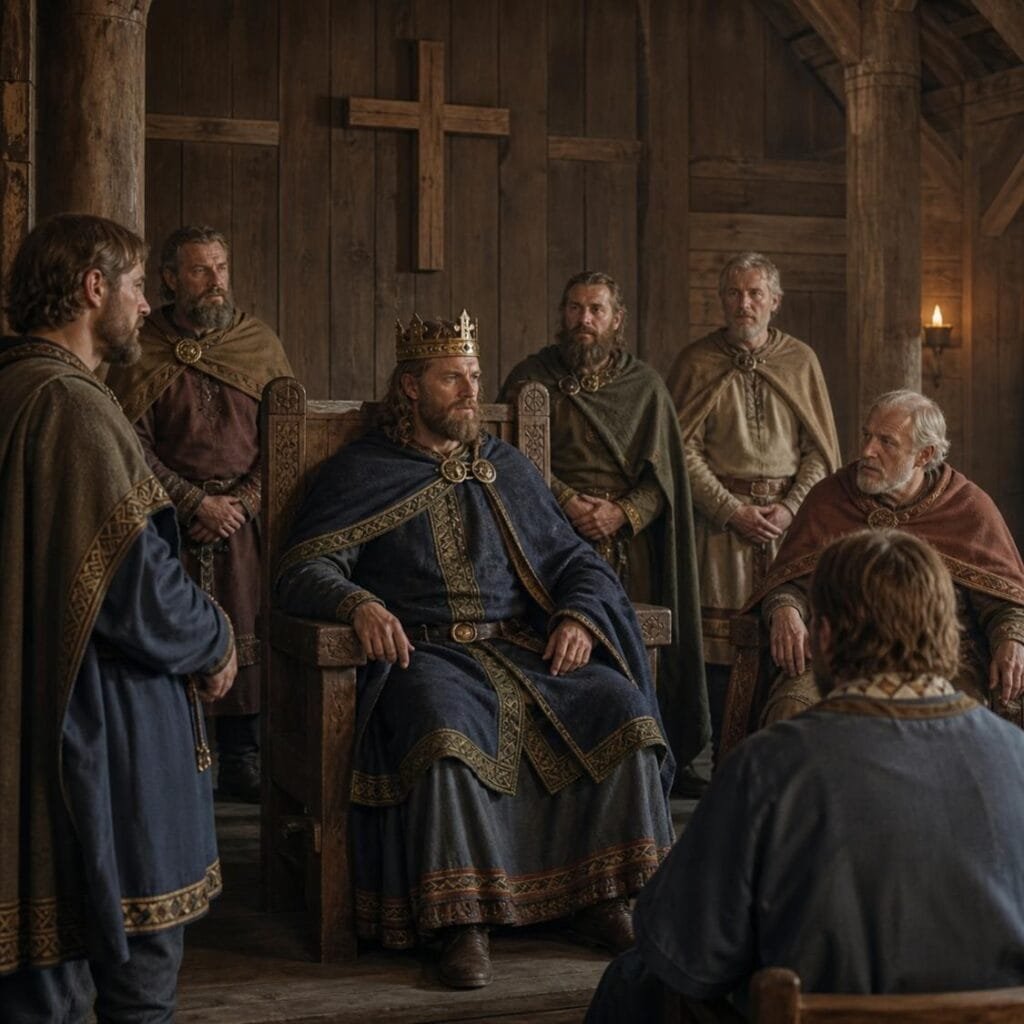
It would be a mistake to imagine court culture as a purely Frankish achievement. Across Europe, elite centers developed their own forms of court life. In Anglo-Saxon England, royal halls were places of feasting, gift-giving, poetry, and political negotiation. In Byzantium, the court preserved a more elaborate imperial tradition, with highly developed ceremonial forms and a strong sense of Roman continuity. In Spain, Italy, Scandinavia, and the Slavic world, courts adapted local traditions to the new realities of Christian kingship and warrior society.
The diversity is important. Court culture in early medieval Europe was never a single uniform thing. It varied by region, dynasty, and political structure. Yet the common pattern was striking: rulers gathered around themselves a community that combined governance, display, learning, and competition. The court was where local aristocracies met broader imperial or Christian ideas. It was where identity was negotiated and where political memory was made.
Literature, memory, and praise
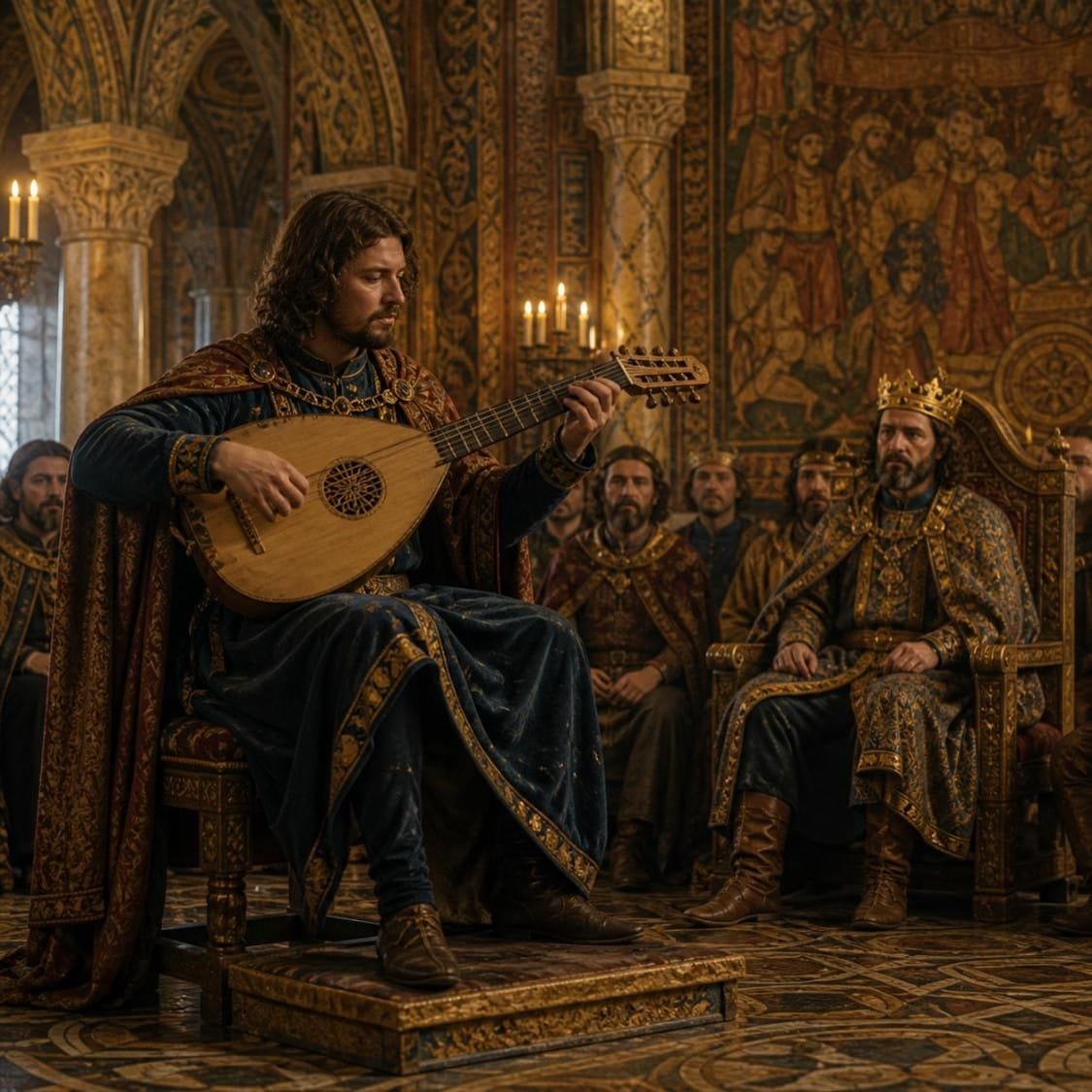
One of the most fascinating aspects of court culture is how much it depended on words. Poets, chroniclers, and panegyrists did not merely record events. They helped create the image of the ruler. Court literature praised kings, commemorated victories, narrated origins, and shaped how future generations would remember power. A successful ruler needed not only victories and treasure, but also writers who could turn those achievements into enduring prestige.
This literary culture was not confined to Latin clerics. In different regions, oral poetry, vernacular traditions, and courtly recitation all contributed to elite culture. Heroes were celebrated, genealogies preserved, and dynastic memory reinforced through stories. The court was thus a workshop of historical identity. It decided who belonged, who mattered, and which deeds would be remembered.
That process helped bridge the gap between the Roman past and the medieval future. Even where political institutions changed drastically, the desire to preserve memory remained. Courts became archives of legitimacy. They remembered bloodlines, battles, saints, and sacred foundations. In that sense, early medieval court culture was as much about controlling the past as governing the present.
Violence and refinement
It is easy to imagine early medieval courts as refined islands in a sea of violence. But in reality, they were deeply entangled with warfare. Kings relied on warrior elites, and many courtly rituals existed to bind armed followers to the ruler. Feasts followed campaigns. Gifts rewarded service. Oaths tied men to their lord. The court was therefore not a retreat from violence but a way of organizing it.
Yet this is exactly what makes court culture so interesting. It transformed raw force into recognizable hierarchy. A noble who came to court did not simply arrive as a fighter. He entered a system of rank, favor, and etiquette. Prestige had to be performed. Loyalty had to be displayed. Even aggression could be formalized. The early medieval court turned a warrior society into a political civilization.
A new political civilization
By the year 1000, court culture had become one of the defining features of European elite life. It had created new standards of rulership, new forms of literacy and patronage, and new expectations about what a king or emperor should be. The court was no longer just the king’s household. It was a political and cultural institution in its own right.
This development laid the groundwork for the high medieval world that followed. Later castles, royal palaces, chivalric culture, and bureaucratic monarchies all grew out of earlier court traditions. The age once dismissed as dark was, in fact, one of the great formative periods in European cultural history.
Conclusion
The rise of court culture in early medieval Europe shows that the centuries after Rome were not culturally barren but deeply creative. Kings and emperors used courts to organize power, display magnificence, reward loyalty, and shape identity. Clerics, poets, scribes, warriors, and nobles all contributed to these spaces, where politics and culture merged. What emerged was not a shadow of Rome, but a new civilization built on adaptation, memory, and ceremony.
The “Dark Ages” were never truly dark. They were lit by hearth fires in royal halls, by candlelight in monastic scriptoria, by jeweled crosses in processions, and by the bright ambitions of men and women who understood that power must be seen, spoken, and remembered.