Imagine waking one morning and looking toward the sun, only to realize that something is terribly wrong.
The sun is still there, but its light seems strangely weak. The sky has an unnatural haze, the air feels colder than it should, and the familiar warmth of summer never seems to arrive. Weeks pass, and farmers begin to realize that their crops are not growing as they normally should.
For the people living through 536 CE, this was not the beginning of a fictional apocalypse. Something extraordinary really was happening to their world.
The sixth century would become one of the most turbulent periods of Late Antiquity. War, famine, disease and political upheaval would affect societies across Europe, the Mediterranean and parts of Asia.
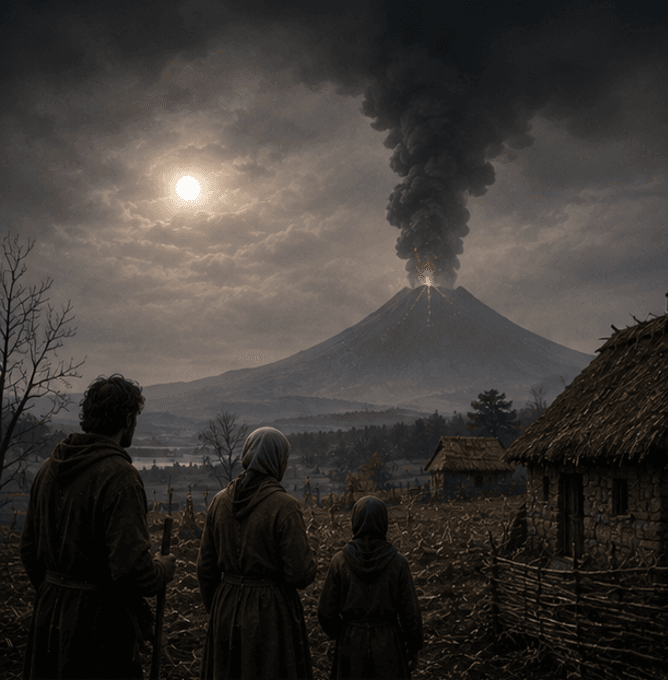
But the crisis appears to have begun with something happening far above the heads of ordinary people: enormous volcanic eruptions that temporarily changed the Earth’s climate.
When the Sun Lost Its Strength
One of the most remarkable accounts comes from the Byzantine historian Procopius, who was writing during the reign of Emperor Justinian I.
Procopius described the sun as giving off light without its usual brightness. It was as though the sun was constantly being dimmed, producing a strange and unsettling atmosphere.
Another writer, the Roman statesman Cassiodorus, described similarly bizarre conditions. He wrote of a sun that appeared pale and unusual, while the normal distinction between light and shadow seemed strangely altered.
Then came the cold. The year that should have brought warmth instead brought unusually low temperatures in many parts of the Northern Hemisphere. Summer crops struggled, growing seasons became shorter, and weather patterns became increasingly unpredictable.
Cassiodorus described a world in which winter seemed to lack its normal storms, spring lacked its usual mildness, and summer lacked its expected heat.
For modern readers, this might sound like an unusual weather event. For sixth-century farmers, it was potentially a disaster.
A World Dependent on the Harvest
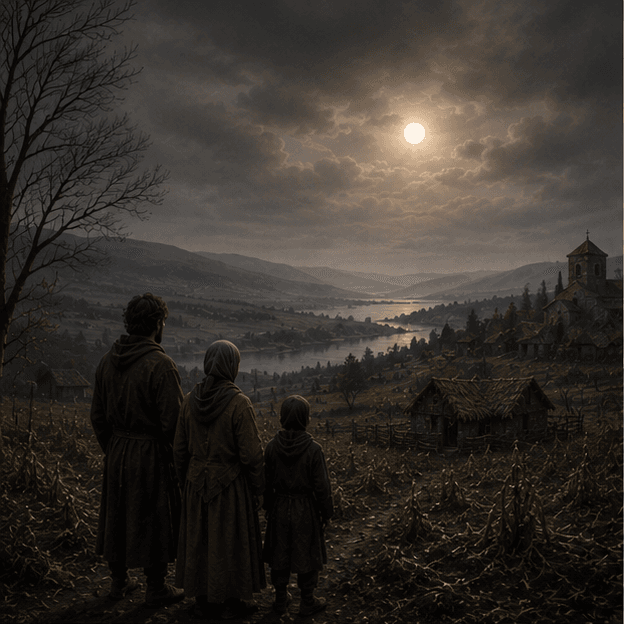
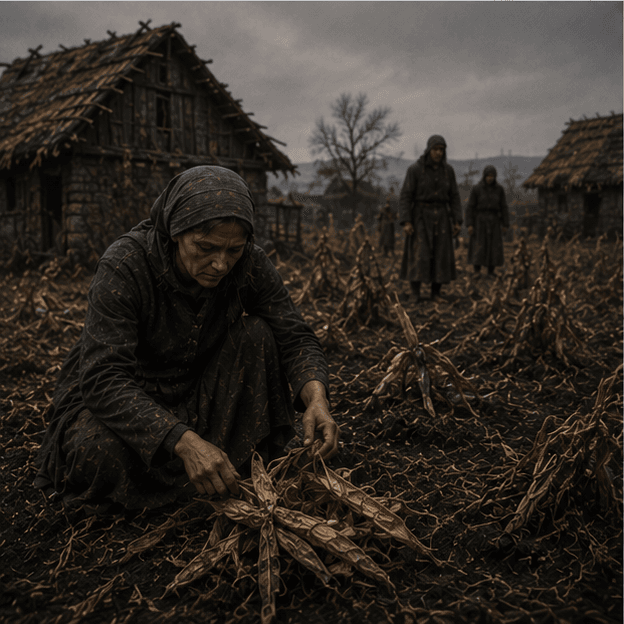
Most people in the sixth century lived in agricultural societies. Their survival depended on a relatively predictable cycle of planting, growing and harvesting.
There were no modern fertilizers, irrigation systems or refrigerated food supplies. There were no global markets capable of moving enormous quantities of grain across continents within days.
A bad harvest therefore meant much more than higher grocery prices. It could mean hunger.
If crops failed repeatedly, families were forced to consume seed grain that should have been planted the following year. Livestock could die because there was not enough food for animals. Monarchs faced pressure to feed cities, while merchants and landowners struggled to protect their own supplies.
The consequences could become a vicious cycle. Less food meant weaker people. Weaker people were more vulnerable to disease. Economic disruption could create social unrest, migration and political instability.
And all of this could begin with a change in the climate that nobody understood.
The Volcanoes Behind the Darkness
Modern science has provided a remarkable explanation for the strange conditions of 536.
When a sufficiently powerful volcano erupts, it can send enormous quantities of sulfur dioxide high into the atmosphere. There, the gas can undergo chemical reactions and form sulfate aerosols – tiny particles capable of reflecting sunlight back into space.
The result is a natural atmospheric shield. Less solar energy reaches Earth’s surface, temperatures fall, and the effects can persist for months or even years.
Evidence for major volcanic activity around this period has been found in ice cores from Greenland and Antarctica. Scientists can examine layers of ancient ice and identify chemical traces left behind by volcanic eruptions.
Tree rings provide another extraordinary piece of evidence. Trees growing during the middle of the sixth century show periods of exceptionally poor growth across parts of the Northern Hemisphere. Their narrow rings indicate that something had dramatically disrupted growing conditions.
The evidence suggests that a major eruption occurred around 536, followed by another enormous eruption around 539 or 540.
That second event was particularly significant because it appears to have prolonged the climatic disturbance.
This means that 536 was probably not simply one terrible year. It was the beginning of a much longer period of environmental stress.
The Cold That Followed
Climate researchers have reconstructed substantial cooling following the eruptions.
The exact effects varied from region to region. Climate change is never perfectly uniform across the planet, and some areas were affected much more severely than others.
But across much of the Northern Hemisphere, the evidence points toward an extraordinary period of cooling.
For people living in the ancient world, even a relatively modest shift in average temperature could have enormous consequences.
Agriculture operates within relatively narrow environmental limits. A crop needs sufficient warmth, moisture and sunlight to mature. Change one part of that equation and the entire harvest can be threatened.
Imagine planting wheat in the spring and watching the summer arrive without enough warmth for the grain to ripen.
Now imagine that happening again. And again. The problem was no longer simply the weather – it was survival.
Then Came the Plague
The sixth century was already politically unstable when the environmental crisis unfolded.
The Byzantine emperor Justinian I was attempting to restore territories that had once belonged to the Roman Empire. His armies fought major wars against the Vandals in North Africa and the Ostrogoths in Italy.
Then another catastrophe appeared.
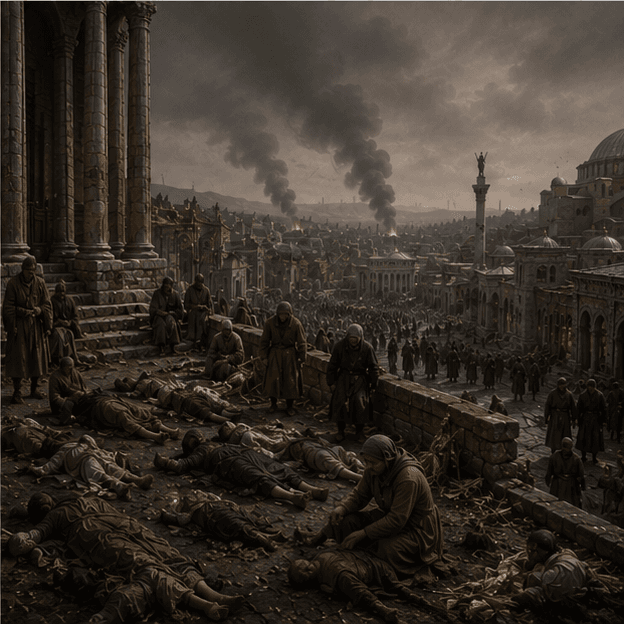
In the 540s, the Justinian Plague began spreading through the Mediterranean world and beyond. The disease was caused by Yersinia pestis, the same bacterium associated with later outbreaks of plague. It killed enormous numbers of people and returned repeatedly in subsequent decades.
The volcanic eruptions did not directly cause the plague. That distinction is important.
But climate disruption may have helped create conditions in which societies were particularly vulnerable. Failed harvests could produce malnutrition, while economic and political instability could weaken communities that were already struggling to cope.
The result was a frightening combination of disasters.
Environmental disruption created stress. Food shortages weakened populations. Then infectious disease struck.
The sixth-century crisis was therefore not caused by one event. It was a chain reaction.
A Crisis That Reached Beyond Europe
One of the most fascinating aspects of the 536 event is that the evidence does not come from a single civilization.
Written records from different parts of the world describe unusual atmospheric conditions. Tree rings from distant regions preserve evidence of severe growing-season disruption. Ice cores contain chemical traces of volcanic activity.
These independent clues allow scientists to reconstruct an event that happened nearly fifteen centuries ago.
Think about how extraordinary that is.
A person living in the sixth century could look into the sky and see a strange, weakened sun. They could not know what was happening thousands of metres above them.
A tree growing during the same period could record the environmental consequences in its rings.
Centuries later, ice could preserve evidence of the eruption itself.
Modern scientists can then bring these clues together and reconstruct the disaster.
In a sense, the Earth kept a record of what happened even when the people experiencing it could not explain it.
Did 536 Destroy Civilization?
This is where the popular story can become exaggerated.
It is tempting to describe 536 as the moment when civilization nearly collapsed. But the reality was much more complicated.
The Roman Empire did not suddenly disappear. Cities continued to exist. Armies continued to fight. Kings continued to rule. Merchants continued to trade, and ordinary people continued to farm, marry, raise children and practice their religions.
Human societies are remarkably resilient. But resilience does not mean that nothing happened.
The sixth century experienced enormous disruption, and climate appears to have been one factor contributing to the difficulties faced by some societies. War had already damaged economies. Political conflicts were already destabilizing governments. The plague then created an enormous demographic shock. Climate disruption added another layer of pressure.
Rather than imagining one disaster destroying the ancient world, it is more accurate to imagine several crises arriving at roughly the same time and interacting with one another.
That makes the story even more fascinating.
What Did People Think Was Happening?
Imagine living in 536 without modern science.
You do not know what a volcanic aerosol is. You have no satellites observing the atmosphere and no meteorological service predicting temperature changes.
You only know what your senses are telling you. The sun looks wrong. The summer is cold. The crops are failing. The seasons seem strangely unpredictable. And nobody can tell you when it will end.
People naturally interpreted extraordinary events through the religious and intellectual ideas available to them. A strange sky could be seen as an omen. A failed harvest could be interpreted as divine punishment. Unusual weather could be understood as a warning that something important was happening.
But people in the ancient world were not incapable of rational observation. Writers carefully recorded what they saw. Farmers understood seasonal patterns from generations of experience. Scholars attempted to make sense of unusual phenomena using the knowledge available to them.
Their explanations were different from ours, but their observations are invaluable. The very fact that ancient writers noticed the weakened sunlight allows modern scientists to compare their accounts with physical evidence preserved in trees and ice.
The Beginning of a Long Cold Period
The environmental crisis did not end when 536 became 537.
Evidence suggests that several volcanic eruptions during the sixth century contributed to a prolonged period of cooler conditions sometimes called the Late Antique Little Ice Age.
The strongest disruption appears to have occurred during the sixth and early seventh centuries, although conditions varied considerably from one region to another.
This prolonged cooling may have placed additional pressure on societies already dealing with war, political instability and disease.
But it is important not to treat climate as a single explanation for everything that happened.
History is rarely that simple.
Climate can create pressure, but human decisions determine how societies respond to that pressure. Some communities may have possessed food reserves, strong governments or access to alternative resources. Others may have been far more vulnerable.
The same climatic event could therefore produce very different consequences in different places.
Was 536 Really the Worst Year in History?
The phrase is dramatic, but it needs to be treated carefully. There is no objective way to identify the single worst year humans have ever experienced.
Different societies have endured devastating wars, famines, epidemics and natural disasters at different times. Someone living in a relatively unaffected region might have experienced 536 as an unusual year. Someone living through repeated crop failures, hunger and disease might have remembered it very differently.
What makes 536 extraordinary is the combination of scale, timing and duration.
A major volcanic eruption appears to have disrupted the climate. Another enormous eruption followed several years later.
Agriculture suffered. Political instability was already widespread. Then plague appeared. It was not one catastrophe. It was a cascade.
The Sun Eventually Returned
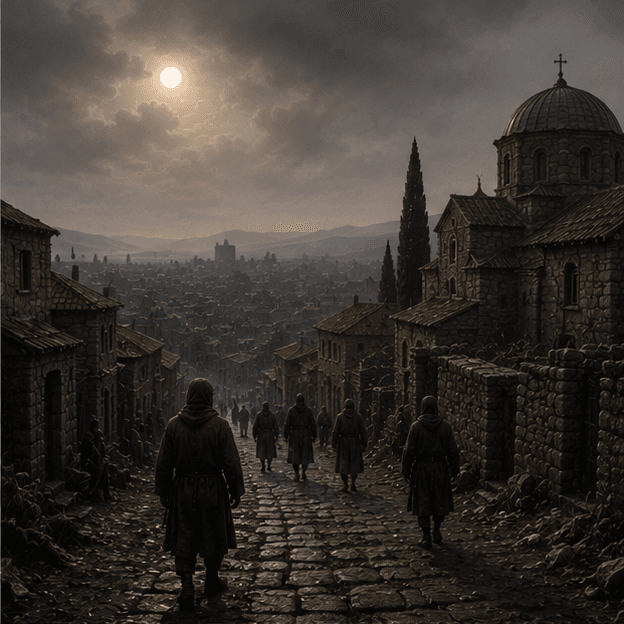
Eventually, the atmosphere cleared. The sunlight returned. Temperatures gradually recovered.
But the consequences could not simply be erased. Harvests had already failed. Populations had already suffered. Governments had already been placed under pressure, and disease had already spread through vulnerable communities.
The world survived. But it had changed.
And perhaps the most haunting part of the story is how little control ordinary people had over it. They could not see the volcanoes responsible. They could not understand the chemistry taking place high above their heads. They could not predict when the sunlight would return. They could only look toward the sky and wonder why the world had suddenly become so cold and strangely dark.
536 CE was not the end of civilization.
But for those who lived through the years that followed, it may have felt as though the natural order itself had broken. And that is what makes the story of 536 so compelling.
Sometimes history changes not because a king declares war or an army crosses a border, but because somewhere far away, a volcano erupts – and the consequences eventually reach everyone.